Friday, 11 October 2013

Devonport, North Shore Auckland


The BARTLEY families in New Zealand all have a strong connection to Devonport, North Shore, Auckland. Edward BARTLEY settled there in 1872. He moved his growing family first to a rented house on the Strand, later building his own home in Victoria Road.

Edward participated energetically in local affairs, serving first on the Flagstaff District Highway Board and, with his friend William PHILCOX on the later Devonport Roads Board. Politics was a serious matter in Devonport in the early years. It was not unknown for animosity between factions to be expressed in both physical and verbal assaults, as the parties held to their firm opinions on the future development of the district. Progressing from the Roads Board to the inaugural Devonport Borough Council, Edward somehow managed to steer a path between opposing parties, exercising diplomacy as he went.

Professionally Edward's contribution to the built environment of his home suburb was considerable. His active involvement in the arts, photography,technical education and music involved his whole family and the Devonport community as a whole.


Foreshore with Mt Cambria behind approx mid 1870s


Boat building on the foreshore approx mid 1870's


Devonport about 1880 taken from a position above the Calliope Rd intersection

In 1880 a fund was started to cover the costs of a larger church of Holy Trinity at Devonport. Fundraising was very much a community affair involving any number of entertainments and fetes. The eldest Bartley children were now young adults and willing musical performers. With their Hannken cousins, Edward's eldest sons formed a popular string orchestra which was much in demand.
Cover of programme Fund Raising Concert September 1880

Programme inner, pages 2 and 3 September 1880


May 1880 Swainson contract
Henry PITTS was a well known builder in Devonport. He worked with Edward on the Holy Trinity Church. Here he lists specifications for amendments to the standard contract to erect a small villa for Mr SWAINSON.

Devonport had the greatest concentration of Bartley designed family homes in Auckland, with the possible exception of Surrey Hills subdivision. Some of these are his simple "copy book" cottages and small villas for working people. These were constructed in multiples during the boom years of the 1880s.
"copy book" workers cottage in Devonport
The most basic were kauri construction with two or four rooms under a hipped roof. The simplicity was often relieved by features such as decorative mouldings at the top of verandah posts. 
In the next price bracket came the single storey villa, of timber usually but also produced in concrete and brick. The interior was dissected by a passageway from front door to back. Two rooms either side of the passage provided the basic living and sleeping quarters. These homes were easily extended with the addition of a lean-to at the back as the need arose. Some sported a filigree valance on the front verandah, with decorative eaves brackets which were picked out in a light colour to enhance the shadow pattern effect.
By the 1880s the bay villa was the last word in modern housing. The basic villa was now modified by the addition of a projection forward- a bay- in one or both of the front rooms. The verandah now protected a smaller porch and the decorative potential of the street frontage was considerably enhanced by the opportunity to include decorative fretwork, bargeboards, finials, brackets and more. This elaborate ornamentation was increasinly emphasised by dark colour such as maroon or green against a lighter weatherboard colour. The verandah roof was often fashionably finished in multi-coloured stripes to match.
At the other end of the market Edward was designing large residence for professionals and the well to do, such a Judge MacDonald's home at Devonport in 1883. The Bartley home was built in 1879 on a lower storey of concrete construction and upper storey of kauri. It was sparsely decorated, as compared to the prevailing fashion, with the enclosing verandah offering the only ornamental feature on the Victoria Road frontage. On the seaward side a single bay extended two storeys, with the verandah returning to allow the best of the views from the elevated site.

Bartley Home corner Calliope and Victoria Road. Image 1879


Premises of R & R Duder corner Church St & King Edward Parade Devonport

The Duder brothers were long term associates of Edward Bartley. They shared a common interest, amongst others, in developing concrete technology in Auckland. The first concrete lighthouse was completed at La Corbiere, Jersey in the Channel Islands in 1873. Local pioneer lime cement was produced at Mahurangi by Wilson and Co. Edward had used their product to erect three concrete villas by 1880. Wilson's agents on the North Shore were the Duder brothers.


Some public projects for which Edward Bartley was commissioned as architect were never constructed, for various reasons.

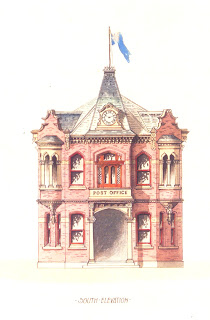
Edward Bartley's 1902 design for Devonport Borough Council incorporating Post & Telegraph Offices, library and council offices is one such case. 
At a special meeting of council in September 1902 Mayor Ewen ALISON and councillors signed and approved the design shown here. It provided for two storey brick council chambers, incorporating post office, telephone exchange and public library in a T shaped plan.
The building plans were then sent to Wellington with the condition and terms of leasing the reserve vested in the Council for the erection of public builidngs. The Council needed to move quickly to have the Government determine the rent before the final parliamentary session in October. The postal authorities also had some say in the final design of their facilities.
By July 1903 Ewen Alison was in Wellington visiting the Postmaster General and looking for a final decision. There was also local and regional opposition to the principal of a Borough Council seizing a recreational reserve for building purposes.
The plans for the civic centre were never realised, nor was the Post Office successful in its alternative plan of acquiring part of the reserve for its own use. When funding finally came for new postal facilities in Devonport it was for comparatively moderate premises in Victoria Road.

1902 Devonport Council Buildings with Post and Telegraph Office


In 1913 a Stanley bay resident Mr A Lloyd brought his proposal for swimming baths before the Devonport Borough Council. The complex he proposed was designed by Edward Bartley. He offered to personally subscribe one third of the cost and suggested a public share issue to raise the balance. A site near the Esplanade was most favoured. 
The idea was scuttled by the old issues of cost and site. There was no position available on the foreshore which would not interfere with the established uses of commercial and leisure craft.

Proposed Devonport Baths 1913
Interior plan of Devonport Baths proposal
The original plan for both men's and womens baths of equal size has been amended to a larger pool for men, leaving the architect with that difficult space "for Future Expansion". This reworking more accurately reflected the sensibilities of the majority of adults of the time. Sixteen private bathing cubicles were provided for each gender for those uncomfortable with communal bathing. Lloyd had visions of completing the complex in time for the Auckland Exhibition opening in December 1913.


Friday, 13 September 2013

Edward Bartley on Native Timber


Edward Bartley


Edward Bartley, like many of his generation, was passionate about the natural sciences and the new understandings of the natural world which occurred with increasing rapidity during the 1800’s. 
We think of our own time as being one of the greatest technological breakthroughs, but the reign of Queen Victoria saw phenomenal advances across a range of fields.
The Museum Institute was a valuable forum for information exchange on scientific and historical matters.
 As an early member, Edward attended the meetings and lectures regularly and, on occasion, presented material himself on topics which interested him personally or professionally.

On arriving in 1854 as a young man, Edward worked in the building trade, with his brother Robert. The construction of the Supreme Court building was an unusual subcontract for them, as it enabled the brothers to work in stone, as they had been used to do in the Channel Islands. Predominantly construction in the Auckland province was in timber – a plentiful resource in the new colony. Yet surprisingly little was known of the native timbers. Their properties and usefulness were still disputed, even after Anton Seiffert had produced outstanding cabinetmaking with carved and marquetry detail using local species.

Edward observed and experimented with local woods and, as an architect, was particularly fond of exploiting their decorative value for interior work. In 1885 he presented a paper to the Institute on the subject of native timbers and their suitability for use in building. An extract of text from this presentation is reproduced for you here:

By Edward Bartley, Architect.
[Read before the Auckland Institute, 30th November, 1885.]
Specimens of Timber to Illustrate the Paper.
Kauri.—Four specimens: Red, white, black, and a soft kind from Tairua.
Piece of kauri joist destroyed by dry rot.
Piece of kauri destroyed by grubs.
Piece of window-sill from St. Andrew's Church, built in 1847.
Rimu.—Piece of 12 in. x ¾ in. board, to show the difficulty in discriminating between sap and heart.
Totara.—Piece with the commencement of small spots of decay.
Kahikatea.—Piece of flooring completely destroyed by the grub.


There are only four kinds of New Zealand timbers used in Auckland for building purposes. I place them in the following order of merit: Kauri, rimu, totara, and last kahikatea. After touching on these various timbers, I propose to say a few words on seasoning and decay of timber. Permit me to remark that the statements are not gathered from hearsay, but from thirty years' experience in the building trade in Auckland. I have of late years taken down buildings that I either took part in erecting or saw erected; I have had, therefore, many opportunities of studying the durability and other characteristics of our Auckland-grown timbers.
First, the kauri (Dammara australis).—I have here specimens of four kinds of kauri: the red, white, black, and a soft kind, quite distinct in grain and quality from the others, which I will hereafter explain. The red kauri is the best general building timber; it is well adapted for heavy framework, beams, joists, and the like; it is close-grained, rather gummy, very durable, but is liable to cast and twist; it shrinks endways as well as in width. The shrinking endways is a great drawback to kauri, and more especially this kind. I have known a forty feet beam shrink 1 ½ inches in length. I have also known a weatherboard shrink ¾ of an inch in twenty feet, and most of us will remember ceiling mouldings and other joiners' work shrinking so as to quite disfigure the building. This red kauri should only be used for beams or other framework, and not for mouldings or joiners' work. The next is the white kauri, a tough kind of timber; will bear a greater breaking strain than the red, but not so durable; I have seen it quite soft in a few years; it is a splendid timber for moulding and joiners' work. The shrinking endways is almost nil, if worked up after a fair amount of seasoning, neither will it cast. It is largely used by boat-builders on account of its readiness to bend. Black kauri is not very abundant, it comes from the west coast of the island, it is only fit for rough work, is heavy with gum, and the most durable of all; in fact, for fencing-posts or the like, I believe it would last as long as puriri. I need hardly say it is not fit for mouldings or joiners' work; it is so hard it would require very strong machinery to work it, and after being worked it would cast into all shapes. The last specimen of kauri (No. 4) is the timber for joiners' work and mouldings; there is a peculiar grain marking in this kind of kauri not to be found in any of the other specimens—this kind should only be used for mouldings and joiners' work. We have often heard it remarked that kauri is noted for its casting, twisting, and shrinking: well, this last kind of kauri will neither cast, twist, nor shrink endways. I have seen slight scantlings, say 3 in. by 3 in., 20 feet long, quite straight, after being exposed to the weather without any care. I have seen joiners' work made up out of this timber standing as well as cedar. I have already said it should only be used for joiners' work and mouldings, it is so light and soft; it should never be used for beams or heavy framework; but if this kind of kauri and the white only were used for joiners' work and mouldings, we should seldom hear of ruined ceilings, and twisted doors and sashes. This kind of kauri is only found in the Tairua District.
The next timber on my list is the rimu (Dacrydium cupressinum). It is known in the South Island as red pine. The rimu, I believe, grows in the South to a very large tree, but in this province the average size tree is two feet six inches to three feet diameter; it is a timber with a large proportion of sap-wood—a two-feet diameter log will have nine inches of sap-wood, leaving only six inches of heart, the heart not being very well defined. By this specimen of rimu (a board twelve inches wide) the difficulty in discriminating between sap and heart will be seen, even by an expert. There is a hard white gum, and frequently many shakes, near the heart, that renders this tree unfit for boards, but it answers well for scantlings, joists, and framework. The sap-wood, if exposed to weather or damp, will not last, but the heart is very durable. I have known rimu fences standing many years. Of course, with kauri so plentiful, we have not used much rimu; but at the rate the kauri is being cut, before many years we shall, I am sure, have to fall back on the rimu. Picked heart of rimu is a very good furniture wood, and very suitable for church furniture.
Totara (Podocarpus totara) is the third timber of importance. It is largely used in the South for building purposes, but in Auckland we only know it as a good “pile” timber, and for that purpose it has not been equalled by either native or imported timbers. I have seen a “stringer” taken from Queen-street Wharf quite sound, after being under water twenty-eight years. Of course it was heart, the sap will not last; hence the folly of using round sticks for piles. All piles should be squared timber—all heart. It is at times specified for plates and window sills, with a view, I presume, that it will last longer than kauri. I think this is a mistake: my experience is that it will not last as long as the heart of red kauri. There is a small “rot” speck found in the heart of mature trees; I have here a specimen cut from a new plank with this kind of decay, still the totara must be classed as one of our most durable timbers.
The last, and the worst of our building timbers, is the kahi-katea (Podocarpus dacrydioides). It will decay very soon, exposed to the weather or damp—in damp situations it will not certainly last longer than four years—and inside, or under cover, such as flooring, ceiling or lining, it is attacked by a small grub, completely destroying the inside of the scantling or board. I have here a specimen of kahikatea flooring destroyed by this grub; the destruction is so complete that I have known a floor rendered dangerous to walk on, the chairs having gone through in many places. I consider kahikatea is far inferior to all sap kauri. If used for rough lining, the perforations made by this grub will appear through scrim and paper of the room; in an instance that came under my notice, one kahikatea board had been fixed for rough lining, the remainder being sappy kauri: the board, scrim, and paper were quite destroyed, like a band nine inches wide, the remaining lining being quite sound. It is said that kahikatea grown on high ground grows better than that grown on low ground; but the greater portion, I should say nine-tenths, grows on flat swampy districts.
Seasoning and Decay of Timber.
The causes of decay are various, the worst being “dry rot”—a term giving a wrong idea of the nature or cause of the decay. I have here a specimen of heart kauri destroyed by “dry rot.” It is covered with a fungus of extraordinary growth in Auckland. I have seen a plant measuring over five feet in diameter. Whether the fungus grows in consequence of the decay, or the decay is caused by the fungus, I am not quite clear; but I should rather think the fungus grows after the decay, and is not the cause of the decay. At any rate we know the first cause is by using unseasoned timber in unventilated positions, such as a ground-floor without a space left for ventilation. Nearly if not all the ground-floors on the east side of Lower Queen-street are decaying with “dry rot.” I have known 12 in. x 3 in. all heart kauri joists quite rotten in twelve years; the joists will break off in pieces from six inches to two or three feet long, and will be found flat on the ground, with square ends, the timber always breaking at right angles to the fibre of the wood. The kauri is also destroyed by a small grub, similar in some respects to the grub in the kahikatea, but with this difference: the grub in the kahikatea always bores with the fibre of the wood; the grub in the kauri will bore in any direction. I have here a sample of kauri bored with this grub. The sap-wood will be attacked first; but if found in a building, it will soon go right through, heart and sap falling a prey to it.
One great reason for kauri and other timber decaying is the constant use of young and unmatured timber. A mature kauri will be at least five feet diameter, showing well defined sap-wood of not more than three to four inches. Now, a large quantity of logs cut up in Auckland will not measure more than 2 feet 6 inches to 3 feet in diameter: this size log will have nine inches of sap-wood, leaving on a log 2 feet 6 inches only 12 inches of heart, and that soft and white. Next to using young timber is the constant use of unseasoned timber, and the practice of our mill-owners cutting down trees all the year round, and full of sap. I consider the trees should be “barked” at least six months before being fallen; the barking, of course, simply means cutting out a ring of bark, say four or six inches in width, close to the ground. Another plan, adopted in America, is to bore two holes right through the trunk, crossing each other in the middle of the tree; either or both are inexpensive operations, and should be tried by the mill-owners. As to the time of year for felling our New Zealand timbers, I consider, if barked or bored as I suggest, it would not matter a great deal. It will be seen at once that if we get rid of the sap or gum before falling we have overcome half the difficulty (if not more) experienced in seasoning. Hence the failure of artificial seasoning by the hot chamber, used a short time ago by some of the mills, the hot chamber simply baking the outside, leaving the sap and gum inside the plank. It is a fact known to all carpenters that kauri will season better in the rain and wind of winter than the hot sun of summer. Most of us know the effect of new kauri shingles on a tank of water: the gum and sap is washed out to such an extent by the rain, that the first water off the roof is like weak turpentine, and dark in colour. Then we have another cause of decay, consequent upon using unseasoned timber, that is the injudicious use of tar. It is right to tar a well-seasoned piece of timber, but utter folly to tar green timber, and all round, as we see repeatedly done in our buildings and wharves. I have known a 4in. x 3in. plate of heart of kauri quite rotten in two years, solely on account of being tarred all round; the proof being that other plates in similar situations, and quite near, were quite sound. If the durability of timber is to be studied, it should be a rule not to paint or tar timber before being seasoned. That kauri will last, I have had many instances brought under my notice. Here is a portion of a window-sill taken from St. Andrew's Church, built in 1847; it will be found not the least impaired by thirty-six years' exposure to the weather. It was removed about two years ago. It was resting on a stone sill; the under side, it will be observed, has not been painted. Only one other instance: The two first grave fences in the Auckland Cemetery, erected thirty-three years ago, are still standing, and quite sound. The posts are of red kauri, and had been charred.


Tuesday, 10 September 2013

Architecture of Edward Bartley

 Each Southern Hemisphere Spring Auckland New Zealand holds a heritage festival. Recognition of our built heritage is an important part of the event.

Bartley Family Archive holds a strong collection for those interested in colonial architecture. Here we share some of those images as our contribution to the Heritage Festival 2013.

All of the buildings illustrated below are associated with Edward BARTLEY (1839-1919).
Edward was born in St Helier, Jersey and emigrated to New Zealand as part of the family group led by his eldest brother Robert BARTLEY.

During his long career Edward served as architect to the Anglican Church, the Auckland Savings Bank and to the Auckland Hospital Board. By the time he was asked to supervise the construction of St Matthew’s in the City in 1901 he had already designed more than twenty churches for various denominations.

To Aucklanders his most familiar designs are the Jewish Synagogue in Princes st, St John’s Ponsonby, ASB building Queen St and the Blind Institute building in Parnell. All of these surviving buildings are designated Category One by the New Zealand Historic Places Trust.

The geographical spread of his designs extends from Whangarei to Cambridge. He also fostered the next generation of notable New Zealand architects – both Gerard Jones and M.K.Draffin were articled to him.

In addition, his early involvement with the Eight Hour Movement, industrial and technical education, the Society of Arts, the Museum Institute and the Devonport Borough Council are just some of his contributions to the growth and development of the Auckland region.

ASB Queen St Cross Section

ASB Queen St Front Elevation


Sailors Home Auckland

ASB Devonport Auckland

ASB Devonport Auckland


ASB Devonport Auckland


Holy Trinity Devonport Auckland

Pitt St Theatre Auckland, now the Mercury **endangered**

Mr Wharfe's House Devonport Auckland

Mr Wharfe's House Devonport Auckland

Mr Wharfe's House Devonport Auckland

Costley Home Auckland

Whangarei Hospital

Blind Institute Parnell

St John's Ponsonby

Waiting Rooms Victoria Wharf Devonport

Wesleyan Church Waiuku

Friday, 23 November 2012

Robert Bartley and Esther Kerby


In this next few posts I would like to share some of the images donated by the descendants of Robert Bartley (Jnr) and Esther Kerby. Thanks to all of the families who gave of their time, research and photographs.


Obituary Robert BARTLEY from New Zealand Herald Friday, 5 Sept 1913

Death of a Jerseyman in New Zealand: An Early Settler

Another of the rapidly diminishing band of early settlers, in the person of Mr Robert Bartley died yesterday at the age of 87, at his residence at Devonport.

The late Mr Bartley was born at Jersey, in the Channel Islands, in 1826, where he was brought up to the building trade. With his wife and three children, he arrived in Auckland by the ship Joseph Fletcher in 1854.

The deceased commenced business here as a builder and contractor, and carried on this work for many years. On retiring from his business he was appointed yard manager for the Kauri Timber Company, which position he held for some time.

For some years past, Mr Bartley has been living in retirement at Devonport. He took a keen interest in public affairs, and was always willing to help forward any deserving cause brought under his notice.

He leaves a widow and the following sons and daughters: Messrs Walter Bartley
(Ponsonby), Charles Bartley (Richmond Rd), Clement Bartley ( Ponsonby Rd),
Edwin Bartley (Christchurch), Mesdames J H Witheford, S G Rountree. S Gilbert & R Tudehope.


Robert and Esther's daughter Julia was born at St Helier on Christmas Eve 1851. Her baptism has not been found in the parish register at St Helier, but it likely to be recorded in the records of the Wesleyan chapel there.
In Auckland, New Zealand Julia met and married Stephen Gilbert ROUNTREE, son of Meredith Rountree and Margaret Ann GILBERT, of Co Armagh, Ireland.
Julia and Stephen were married at the Bartley home in Nelson St, Auckland on 19 Dec 1874.


Julia Bartley
The Children of Stephen Rountree and Julia Bartley

Eva 1876 - 1933 ( m Arthur Ferneyhough)
Harry 1878-1950 (m Stella Stewart)
Maud 1879 - 1965 (m Samuel Barry)
Vera 1881 - 1961 (m Percival Mourant)
Zillah 1884 - 1974 (m William Ray Ellingham)
Myrtle 1888 - 1966 (m Horace Richards)
Edward (Ted) 1890 - 1976 (m Anne Rae)

Search copy of Marriage Register Entry


Julia


Saturday, 17 November 2012

Queree Connections


Continuing with the children of Robert BARTLEY and Betsy BENEST, of St Helier, Jersey, Channel Islands

Amelia Bartley and John Queree in 

New Zealand


Amelia Bartley was born in September 1841. After her father died she left Union Court and, with her siblings Louisa and Alfred, went to live with their sister Jane Hamon. Jane and Charles Hamon ran a drapery business in St Helier. Amelia was employed as their drapery assistant. Shortly after the census was taken in 1861 she married John Queree.
 John was born on Jersey about 1839, a child of John QUEREE, a mason, and Joanna GEACH, a dressmaker. His mother was born in Ireland.  He had a sister Joanna who was born in 1840.
In 1841 the family lived in Albert St, St Helier but his father died about 1850. They are recorded in the census of 1851 at 2 Columberie St. John was twelve at the time. 
1851 census Queree

In 1854 his mother remarried to Mr Shapcott. The family enlarged then with the birth of Ada Shapcott in 1855 and Mary in 1858. Mr Shapcott died about 1860. John was living at home with his mother and step-sisters in 1861, at 34 King St.  John’s mother passed away between 1862 and 1871.
1861 census Queree

About 1857 John’s sister Joanna married John Hutton SNOOK, a master mariner. Their family included Henry (1858), Joanna (1859), Adolphus (1861), John (1862), Evelyn (1863), Jessie (abt. 1866), Maude (1866), Annie May (1867).
By 1871 she was a widow with eight children of her own, as well as the care of her step sisters Ada and Mary. 
Joanna must have been a capable person as family research suggests she was an accomplished and active musician. She also worked with her brother in his business.

John Queree worked as a boot maker in the town, not far from Hamon’s drapery. He and Amelia set up home at 19 Trinity St in St Helier. Their first child John, born 1863, died as an infant.  Earnest (b 1864), Theodore (b 1865), Amelia (1868), Florence (1869), who died young, and Walter (1872) completed the family. Just after Amelia was born they moved again to 29 King St. 

 All of the Queree children went to work in their uncle Hamon's drapery business when they reached the age of 14. The footwear business was unable to support them all. 

The letters home from Auckland in the early 1880's would have been very positive in tone.
Auckland was booming. Edward was well established as an architect. Robert was looking forward to a comfortable retirement, his children having made successful careers and marriages in New Zealand. 
About 1882 John and Amelia Queree made the decision to emigrate to Auckland to join Robert and Edward and their families.
John's sister Joanna had already left St Helier. She remarried in 1881, to Thomas LE SUEUR. This couple were married and lived in Brighton, England. (BDM2b406202) Joanna died there in 1903.

All the Queree family except Earnest are listed on the passenger list of the 'Westmeath' which arrived in Auckland on the 16th of May 1883.[1]  Earnest gave his arrival date as 1884 but his ship has not yet been found.

At first John pursued his trade as a boot maker, but the Queree’s were barely settled in Auckland before the economy tightened. 
In the late 1880's and early 1890's the town experienced it’s most severe depression. In 1891 they lived at Hepburn St, with all except Earnest at home. He may have been living with his uncle Edward’s family in Devonport for several years. In 1899 the Queree’s were living in Kent St, moving later that year to Hepburn St.
Earnest carried on his earlier trade as a draperer and was employed by Milne and Choyce and later with DSC. He married Maria PHILCOX in 1889 at Devonport. Alf Bartley was best man at their wedding.

The Philcox Connection

Maria’s father was a builder in Devonport and a friend of Edward Bartley’s. William Philcox was about the same age as Edward, being born in 1838. He arrived in Auckland on 8 August 1856 aboard the Lord Burleigh.[2] He married Sarah Elizabeth Rose the year after. 
In the Jury list for 1858 he is listed as a carpenter of Barrack St. The first of their children was born at Khyber Pass, which was to be the family home until their later move to the North Shore. He may have been employed by E.I.Matthews and worked with Edward from his first days in the Colony. They were both founder members of the Eight Hour Movement in Auckland.
By 1862 he owned two other properties at 92 and 94 Albert St which he rented out.[3] He was in partnership with another carpenter, a Mr Vaughan from late 1863 until August 1866. They worked from leased premises on the corner of Albert and Wellesley St.[4]
At this time Edward was in partnership with Seering Matthews, as Matthews and Bartley. They owned their premises in Grey St. On the night of 7 February 1867 fire broke out there, completely engulfing the building and sweeping through neighbouring properties. While the property itself was insured there was a complete loss of all stock and machinery, including work in progress to complete contracts. Financially it was a particularly difficult period for the Bartley family, as the year before a rental property Edward owned on the corner of Drake St, leased to Mr Conway the shoemaker, had been gutted in a similar spreading fire. [5] 
The Matthews and Bartley partnership, begun on 2 Jan 1865 was dissolved 26 Feb 1870[6] and Edward continued as a sole trader until he and William Philcox went into partnership together about 1873. The two men shared a musical interest as well. They were founding members of the Auckland Choral Society and sang together in the Christies Minstrels in the 1860’s.
Together they had moved to Devonport and joined the parish of Holy Trinity there. Both Mr Philcox and Edward Bartley served as choir masters for the parish at various times. In 1875 they presented a pair of kneeling stools to the parish and a donation of £35 towards a new organ. [7] Later they designed and presented a new lecturn.
William Philcox died at Buchanan St Devonport in July 1917.[8] 

Maria Queree (nee Philcox) was a very talented pianist, active in the Devonport Musical Society, as were Earnest and Theo Queree, along with their Bartley cousins. The families’ interests meshed throughout Auckland arts and cultural groups.
At the Philcox home in Devonport, called “The Shrubbery” for it’s extensive gardens, she held At Home recitals from her late teens. These events, and the public accompaniments and recitals she was engaged for, brought the Philcox family into contact with most of the local and overseas talent. As she wished to continue her career after her marriage Maria needed suitable premises from which to continue the teaching, recitals and networking demanded by her profession. Her father built a home in Devonport for the young couple as a wedding gift.[10]
After her marriage Maria travelled widely, appearing regularly in recitals and concerts in Wellington. In April 1893 she advertised in the Evening Post as a tutor of pianoforte. [11]  This was the same year she made her debut in Wellington as an accompanist. The occasion was a benefit concert to raise funds for Miss Fisher to study in Melbourne.  From the beginning her Wellington engagements were steady. [12] . The couple were still resident in Auckland however.[13] Their young daughter Renee was often present at the At Home concerts as a toddler. 
Observer 3 July 1899

In later trained years Renee trained in Berlin and toured England as an accompanist in 1913, staying with her brother Theo Jnr while she was in the UK. She came back to New Zealand just before the outbreak of the war as her father had died in May 1914. [14] He was buried at Karori Cemetery with a memorial cross provided by his Auckland friends.

The Queree brothers moved to Wellington about 1900 to set up their drapery business at 116 Willis St, formerly Walsh’s.[15]Walter Queree had also been living in Auckland and joined the business in Wellington about that time. He had survived a distressing experience at New Year in 1899. He was boating at Lake Pupuke with his friends the Hall brothers. Tracey Hall, well known in amateur operatic circles, was unable to swim. He drowned on the lake despite Walter’s attempts to save him.[16]

Theo Queree was in employment as a tailor and later window dresser for Milne and Choyce. He was active as costumier for the Choral Society and amatuer operatic societies in Auckland. He designed the sets for many of theatrical events held in Devonport and was well known as a talented artist, singer and musician as well. In March 1895 he joined with Alf Bartley and his sister Amelia to perform at the concert opening the annual show of the Birkenhead and Northcote Fruitgrowers.[17] He also sang at the very fashionable occasion of a soiree at the home of R.H.Abbott, where Alf Bartley was the principle accompanist. He remained in Auckland until about October 1903 when he left for Wellington to work initially for D.I.C.[18].

Amelia Annie had stayed at home with her parents. In 1892 she met John Pollard MOUZER, a teacher, whose father and uncle were tailors. John had been born in Suffolk and immigrated with his family to New Zealand. They were married in the All Saints Church in Auckland on the 27th of December 1892. By this time her Father was in his fifties and employed as a warehouseman. 
The Mouzer’s made their home in Selwyn St in Auckland. By 1899 John Mouzer was working as a piano tuner. Unfortunately neither their finances nor their marriage had prospered and the couple separated about that time.
Amelia Bartley died in Auckland on 9 August 1903. She was buried at Purewa.

  After his wife’s death John Queree went to join his sons in Wellington. He remained there until his death in 1913 at Nurse Jackson’s private Hospital[19], suggesting that he was not in good health at the time of Amelia’s death. His remains were returned to Auckland where he was buried beside his wife on 22 June 1913.

The Children of Amelia Bartley and John Queree

John Alfred (1863-1864)
Earnest Hugh (1864-1914)
Theodore George (1865-1954)
Amelia Annie (1868-?)
Florence Louisa (1869 - ?)
Walter John (1872-1944)


[1] Auckland Evening Star 17 May 1883
[2] Daily Southern Cross 12 August 1856 p2
[3] Ibid 27 December 1862
[4] Ibid 21 August 1866; 23 August 1866 p3
[5] Ibid 8 Feb 1867 p3; 9 Feb 1867 p3; 19 Nov 1866 p4
[6] Ibid 2 March 1870
[7] Daily Southern Cross 26 Jan 1876
[8] Auckland Weekly News Obit 26 July 1917
[9] Evening Post 23 July 1917 p8
[10] The drawings for Maria’s house are held at Auckland University Architecture Library, along with the remaining Philcox papers.
[11] Evening Post 14 April 1893
[12] Ref Evening Post 19 June 1983; 20 July 1893; 9 Oct 1893
[13] Ref Evening Post 27 April 1895 where Earnest makes a submission to the Tariff Commission for free admission of musical instruments to be used for worship. Also Observer 3 Jul 1899 re: at home concert.
[14] Evening Post 15 July 1914
[15] Evening Post 26 August 1908
[16] Thames Star 3 Jan 1899
[17] Observer 2 March 1895 p 10
[18] NZ Free Lance 17 October 1903
[19] Evening Post 21 June 1913 p1