Showing posts with label queree. Show all posts

Wednesday, 4 November 2015

Edward Bartley & Holy Trinity, Devonport, Auckland


The Anglican Church of Holy Trinity was constructed in 1865.  The congregation more than doubled during the next ten years. This phenomenon was general to the district. The population of Devonport increased during the 1870's to just under 1000 residents. The pressure to enlarge facilities was felt by all religious and social organisations in the community.

A decision was made in 1874 to enlarge the existing church by extending the nave and aisles by 9 feet. Edward Bartley prepared the plans which were executed by Henry Pitts. At this time Edward was still operating predominantly as a master builder. By 1877 when a meeting of the Vestry agreed that a larger church was urgently required, it was Edward Bartley, now a practising architect, who was asked to draw plans for a new church. It is likely that his later appointment as Diocesan Architect was facilitated by this early involvement with Holy Trinity.

It was another three years before these plans for the church were accepted as real financial constraints dictated the pace of development. There were other calls on any money available for building. Funds were needed to purchase the house being rented and used as a parsonage. The Sunday School was also seriously overcrowded. 

All these projects relied on subscriptions and donations from the community. Over £400 was found to buy the parsonage and extend the school room during 1878. At the same time residents were being called on to support other community projects for education and arts facilities, meeting spaces and infrastructure. Consider how this level of commitment by the community compares to the average rate of charitable donation today. 


The Programme for one of several fundraising concerts organised by Alf Bartley with his father Edward in 1886.
 Image BFA 2003

The whole community rallied around to support the project with a number of entertainments and fetes.  One of the most successful event was a week long Egyptian Fair held in 1886. The drill shed at Devonport was transformed into the ancient East.
Edward Bartley worked with his son Alfred to design the stalls as stage sets. He had the professional assistance of his nephew Theo Queree, a recent Jersey immigrant who was particularly skilled in operatic stage design. Devonport resident H. N. Williams provided his considerable artistic flair and the benefit of his extensive travels in the Middle East. Visitors entered the Temples of Isis and Osiris, passed between columns and past friezes faithfully imitating the ancient style. The triumph at the eastern end of the stall was a desert sunset. Purchasers responded generously, delighted to buy fancy work and preserves from the matrons and young ladies suitably attired in a chastely Victorian version of Egyptian costume.

During 1884 the parsonage property was sold at a profit and Edward was asked to design a new vicarage within the £600 realised. £860 was required to construct the chancel and transepts of the new church, which was builder William Philcox's lowest tender.  The temporary sections were to be plain, functional and cheap. New building began at eastern end of the old church, which served as the nave in the meantime. 

The temporary solution for Holy Trinity 1883 Image APL SGGSC

The next stage was erected over the old building during 1886. This old church was  taken away and reconstructed on a section behind the new one. There were still plans to add a further ten feet to the front of the new church, along with a tower, spire and south porch.

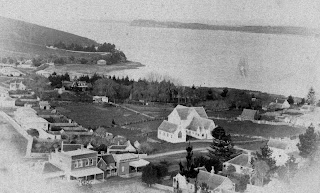
 View of Holy Trinity, Devonport and surrounds, showing the new church with the old on an adjacent section c 1887. Image BFA
 From the south window, with its elaborate gothic tracery, to the joinery of the seats and fittings, this Church fills with soft light and texture- a celebration of wood and worship. 
Interior view, Holy Trinity, Devonport, Auckland. Image BFA 2003
All of the fittings were supplied by the congregation. Edward designed a new pulpit in native timbers to complement the interior, which was placed in the Church in time for its completion.
Pulpit Holy Trinity, Devonport, Edward Bartley. Image APL SGGSC 5896
No asset or effort was wasted. The Sunday School had again outgrown the space available so the schoolroom was hoisted onto skids and moved down to be joined to the old church.
The next building project proceeded immediately with the construction of the new Vicarage in 1887. There was then a pause until the new hall was built in 1910. This was financed by a mortgage. Edward Bartley, along with Humphrey Duder and George Hunt were appointed trustees for the property until it became debt free. 

A 1929 view showing the vicarge in the centre and the hall to the left. A glimpse of the church can be seen on the right. Image Sir George Grey Special Collections, Auckland Libraries, 4-5899

Edward died in 1919 and Duder in 1927, after which the property was vested in the Diocese, marking an end to the establishment phase for Holy Trinity. Plans for the third and final phase of building the tower and spire and south porch were never realised. 
Image BFA 2003


Thursday, 14 May 2015

Clement Bartley- Banking, Bicycles, Birds and other matters

Clement Bartley at forty, an image taken by Hanna photographers for the Cyclopaedia of 1902


Clement Bartley was born in Auckland, New Zealand on the 6th of October 1862. He was the seventh child of Robert Bartley and Esther Kerby.
In many ways Clement's experience was typical of a new colonial born generation. He was educated locally at the Grammar School in the city and later at the training college run by Josiah Martin. He was groomed for white collar work rather than the building trade which his father had followed.
After serving his clerical apprenticeship in the office of the estate agent F. Ewington, Clement began his banking career at the Auckland Savings Bank headquarters in Queen St in 1881. Five years later he received his first managerial appointment in charge of the newly established Newton Branch of the bank. During his long career he managed the new Queen St premises, designed by Edward Bartley, and retired in 1931 after fifty years of service - a time which saw phenomenal changes in banking practice and great swings in the economic climate of the region.

Clement married in 1884. His bride was Ellen Fisher, a daughter of John Fisher and Eliza Dyos. The Fisher's had come from Birmingham to New Zealand in the early 1860's.
Six years later Ellen's sister Emily married Clement's Jersey-born cousin Martin Hamon.

Ellen and Clement's first child was Zoe, born in 1885. Russell, Alva and Graham followed in quick succession. Rita, Freda and Stella completed the family.
Russell as an infant, Image Steven Album, BFA

The eldest child, Zoe. Image Steven Album, BFA


Clement enjoyed a full life of diverse interests. He was an active member of the Birkenhead Borough Council during the 1890s.
Today he would be called a fan of 'extreme sport'. He was a founder member of the Auckland Bicycle Club, later the Waitemata Cycling Club. The club was established in 1881 and on their first outing Clement was riding his newly imported high wheeled machine, one of the first to be brought into Auckland from America. These bicycles are now more often referred to as a penny farthing cycle.

High wheeler bicycles presented their own challenges to riders. Later versions developed moustache shaped handle bars to allow for knee clearance but in the early days it was a real challenge for a tall rider to maintain his seat. The chief danger was going over the top of those handle bars or of going off backwards on the uphill beat. These machines were not equipped with chain drive, brakes or other safety features although they did benefit from the development of a rubber tyre and wheel bearings.
Thanks to Etsy Store 'TheGrandRewiew' for this image of Pope's advertising 1881

A cycle club might seem like a tame pursuit but this was a high risk, high profile sport in these early days. The club met for a weekly excursion over the summer months from September to February. Warmer weather offered only marginally less challenging roads. The surfaces they took to would give modern cyclists pause today with their list of hazards from poor sealing (if any), subsidence and steep gradients. The whims of other road users remain as a challenge for cyclists down to our own time. The attitudes of those in charge of larger four wheeled vehicles were sometimes just as antagonistic as riders report experiencing on our modern roads today. These circumstances, along with the rapid development of cycle technology after the 1880's made for high adrenalin club runs.

'Sir George Grey Special Collections, Auckland Libraries, 7-A6730' Members of Waitemata Cycle Club 1884, Hanna Photographers, Clement Bartley 2nd from right, front row.


Clement was a keenly competitive pigeon fancier and breeder of fowl. This interest absorbed a good deal of his leisure time as well as being a 'space hungry' hobby. He purchased an extra section near his home which he fitted out for his fowl breeding. The Suburban Poultry Club gave regular exhibitions of their livestock and Clement served for many years as an office holder.

Auckland Weekly News 28 July 1899, Clement centre back row

A prize bird, AWN 2 July 1900


Photography was a passion of Clement's, which he shared with his uncle Edward Bartley and cousins Frederick Bartley, Martin Hamon and Ernest Queree. Music was another life long interest involving family, friends and the wider community. Both he and Ellen were talented musicians who fostered a love of music in their children. Their daughter Zoe enjoyed a successful career as a pianist, partly as a result of the rich exposure to musicianship which she enjoyed at home.
Clement served for many years as conductor of the choir at St John's Wesleyan in Ponsonby as well as the Zion Church Sunday School in Birkenhead.
He also enjoyed membership of the Orphan's Club, a social association which fielded an excellent orchestra.
The Auckland Orphan's Club Orchestra about 1913, Clement at far left of back row. Sir George Grey Special Collections, Auckland Libraries, 31-WP533


Clement and Ellen are interred at Waikaraka Cemetery, Onehunga, Auckland. Clement died on 16 July 1936, followed by Ellen on 21 September 1942.

NZ Herald 19 July 1936
Research by M W Bartley

Friday, 29 November 2013

Alfred Martin Bartley 1866-1929

Alfred Bartley, Steven Album, Bartley Archive


Alfred was the third child of Edward BARTLEY and Elizabeth HANNKEN. He was born at Union St Auckland 24 January 1866[1] and his early schooling was at Devonport School. He and Frederick were close companions. Alf was an exceptional musician, with a particular strength in keyboard performance, although he also played string instruments with great facility.
He often appeared at the City Hall as accompanist to visiting musicians. His work with the child prodigy Celia DAMPIER was particularly admired.

Observer 25 July 1891 p 14

In the  1880s Fred, Alf and Bertha Bartley performed regularly as a musical trio. Sport, music and social activity characterised the flourishing Devonport community at this time, just as it does today. One such example is the vibrant culture of the tennis club.  The names mentioned in these newspaper extracts include Alfred's relatives: Queree, Philcox, Mouzer and Mason for example. 
Alf also served as secretary of this Club in the 1890's. 


Observer 30 April 1887

Observer 6 July 1895

Apart from his personal performances Alf was involved with numerous musical groups as accompanist, trainer or organiser - including the Waitemata Minstrels and the Savage Club. His father Edward was a founder of the Orpheus Club and Alf joined him in that group, first as a singer and later as choir master.

Cover page of the Photograph Album presented by the Waitemata Minstrels, Steven Family Collection 

Alf appears in the centre, in civvies. This photo is unidentified and undated. Any information identifying the subject band would be highly appreciated.

Auckland Star 14 July 1922 Jazz age music after the war
Alfred served with the local Borough Council after the war years. He was also a force behind the resurgence of croquet in Devonport in the 1920s:


 Alf was not so happy in his working life. His natural inclination was to a musical career, but the economic reality dictated otherwise. He trained as a draughtsman and worked with various firms in Auckland until the depression of the 1890s when he was out of work.[2] His father gave him what work he could, but both he and Alf were aware that there was insufficient new building to support another a full wage from the architectural practice.

The engagement between Alfred and Miss Essie GRATTAN was announced in July 1890, with those of his brother and sister.[3] Essie was the only daughter of Richard Grattan, and once diagnosed with Bright’s disease, shortly after her engagement, her health deteriorated rapidly. 
Fred and Alfred both had their career prospects  curtailed by depression, an experience shared by many of their generation.
The brothers went to Australia, planning to join the mineral boom in Queensland, but Alfred returned home to New Zealand within a few months. 
Neither of the brothers had found immediate employment overseas and Essie's illness now became obvious and critical. He returned to Devonport.

The Archive holds on file an undated letter from Alfred’s mother Elizabeth. She is writing to Fred in Australia, sharing family news. In it she remarks on Alfred’s situation:
 I think Alf has given up all ideas of getting married. Essie is still very poorly and 4 Doctors tell the same tale that she can't live long although she is usually bright. Sometimes she doesnt know she is bad and talks to Alf about getting married. It is something awful for both. The Doctor thinks if she knew she would give up altogether so they dare not tell her.

Essie died 10 April 1894.[4]
 
Auckland Star 11 April 1894


Once Fred died, in June 1899, in Australia there seems to have been a change. From this time onwards Alfred appeared to be groomed to take over his father’s practice, eventually being made a partner in Bartley & sons, Architects.
 Alfred, however, never shared his father’s passion for architecture and after Edward died Alf left the partnership to their young partner Keith Draffin.

At the New Plymouth in February 1906 Alfred married Marianne Houghton Warren. She was born in Wagga Wagga, Australia 17 Feb 1883. She attended school in Hawera before coming to Auckland to train in nursing at the Mater Hospital in Epsom. [5]

Employment took a new turn, as the twentieth century began. Alfred began a new career as a land agent with Cowpermore-Jones.  He also worked with Hancock and Co around the time of the lifting of Prohibition. Hotels, previously run as boarding houses were undergoing conversion back to licensed premises. He travelled widely supervising alterations to his plans.[6]

Alfred died in Pentlands Hospital, Devonport on 1 May 1926. He is interred at O’Neill’s Point Cemetery.[7]


[1] Daily Southern Cross 28 February 1866 page 7
[2] Electoral Roll 1883 Eden. Resident Devonport Draughtsman. 1889 witness at wedding of cousin Ernest Queree, occupation draughtsman. Cert on file.
[3] Observer 26 July 1890
[4] NZRBDM 1894/2585
[5] Steven Family research
[6] Steven family research
[7] Probate 323/29. Burial May 1929 Cemetery Records O’Neill’s Point


Saturday, 17 November 2012

Queree Connections


Continuing with the children of Robert BARTLEY and Betsy BENEST, of St Helier, Jersey, Channel Islands

Amelia Bartley and John Queree in 

New Zealand


Amelia Bartley was born in September 1841. After her father died she left Union Court and, with her siblings Louisa and Alfred, went to live with their sister Jane Hamon. Jane and Charles Hamon ran a drapery business in St Helier. Amelia was employed as their drapery assistant. Shortly after the census was taken in 1861 she married John Queree.
 John was born on Jersey about 1839, a child of John QUEREE, a mason, and Joanna GEACH, a dressmaker. His mother was born in Ireland.  He had a sister Joanna who was born in 1840.
In 1841 the family lived in Albert St, St Helier but his father died about 1850. They are recorded in the census of 1851 at 2 Columberie St. John was twelve at the time. 
1851 census Queree

In 1854 his mother remarried to Mr Shapcott. The family enlarged then with the birth of Ada Shapcott in 1855 and Mary in 1858. Mr Shapcott died about 1860. John was living at home with his mother and step-sisters in 1861, at 34 King St.  John’s mother passed away between 1862 and 1871.
1861 census Queree

About 1857 John’s sister Joanna married John Hutton SNOOK, a master mariner. Their family included Henry (1858), Joanna (1859), Adolphus (1861), John (1862), Evelyn (1863), Jessie (abt. 1866), Maude (1866), Annie May (1867).
By 1871 she was a widow with eight children of her own, as well as the care of her step sisters Ada and Mary. 
Joanna must have been a capable person as family research suggests she was an accomplished and active musician. She also worked with her brother in his business.

John Queree worked as a boot maker in the town, not far from Hamon’s drapery. He and Amelia set up home at 19 Trinity St in St Helier. Their first child John, born 1863, died as an infant.  Earnest (b 1864), Theodore (b 1865), Amelia (1868), Florence (1869), who died young, and Walter (1872) completed the family. Just after Amelia was born they moved again to 29 King St. 

 All of the Queree children went to work in their uncle Hamon's drapery business when they reached the age of 14. The footwear business was unable to support them all. 

The letters home from Auckland in the early 1880's would have been very positive in tone.
Auckland was booming. Edward was well established as an architect. Robert was looking forward to a comfortable retirement, his children having made successful careers and marriages in New Zealand. 
About 1882 John and Amelia Queree made the decision to emigrate to Auckland to join Robert and Edward and their families.
John's sister Joanna had already left St Helier. She remarried in 1881, to Thomas LE SUEUR. This couple were married and lived in Brighton, England. (BDM2b406202) Joanna died there in 1903.

All the Queree family except Earnest are listed on the passenger list of the 'Westmeath' which arrived in Auckland on the 16th of May 1883.[1]  Earnest gave his arrival date as 1884 but his ship has not yet been found.

At first John pursued his trade as a boot maker, but the Queree’s were barely settled in Auckland before the economy tightened. 
In the late 1880's and early 1890's the town experienced it’s most severe depression. In 1891 they lived at Hepburn St, with all except Earnest at home. He may have been living with his uncle Edward’s family in Devonport for several years. In 1899 the Queree’s were living in Kent St, moving later that year to Hepburn St.
Earnest carried on his earlier trade as a draperer and was employed by Milne and Choyce and later with DSC. He married Maria PHILCOX in 1889 at Devonport. Alf Bartley was best man at their wedding.

The Philcox Connection

Maria’s father was a builder in Devonport and a friend of Edward Bartley’s. William Philcox was about the same age as Edward, being born in 1838. He arrived in Auckland on 8 August 1856 aboard the Lord Burleigh.[2] He married Sarah Elizabeth Rose the year after. 
In the Jury list for 1858 he is listed as a carpenter of Barrack St. The first of their children was born at Khyber Pass, which was to be the family home until their later move to the North Shore. He may have been employed by E.I.Matthews and worked with Edward from his first days in the Colony. They were both founder members of the Eight Hour Movement in Auckland.
By 1862 he owned two other properties at 92 and 94 Albert St which he rented out.[3] He was in partnership with another carpenter, a Mr Vaughan from late 1863 until August 1866. They worked from leased premises on the corner of Albert and Wellesley St.[4]
At this time Edward was in partnership with Seering Matthews, as Matthews and Bartley. They owned their premises in Grey St. On the night of 7 February 1867 fire broke out there, completely engulfing the building and sweeping through neighbouring properties. While the property itself was insured there was a complete loss of all stock and machinery, including work in progress to complete contracts. Financially it was a particularly difficult period for the Bartley family, as the year before a rental property Edward owned on the corner of Drake St, leased to Mr Conway the shoemaker, had been gutted in a similar spreading fire. [5] 
The Matthews and Bartley partnership, begun on 2 Jan 1865 was dissolved 26 Feb 1870[6] and Edward continued as a sole trader until he and William Philcox went into partnership together about 1873. The two men shared a musical interest as well. They were founding members of the Auckland Choral Society and sang together in the Christies Minstrels in the 1860’s.
Together they had moved to Devonport and joined the parish of Holy Trinity there. Both Mr Philcox and Edward Bartley served as choir masters for the parish at various times. In 1875 they presented a pair of kneeling stools to the parish and a donation of £35 towards a new organ. [7] Later they designed and presented a new lecturn.
William Philcox died at Buchanan St Devonport in July 1917.[8] 

Maria Queree (nee Philcox) was a very talented pianist, active in the Devonport Musical Society, as were Earnest and Theo Queree, along with their Bartley cousins. The families’ interests meshed throughout Auckland arts and cultural groups.
At the Philcox home in Devonport, called “The Shrubbery” for it’s extensive gardens, she held At Home recitals from her late teens. These events, and the public accompaniments and recitals she was engaged for, brought the Philcox family into contact with most of the local and overseas talent. As she wished to continue her career after her marriage Maria needed suitable premises from which to continue the teaching, recitals and networking demanded by her profession. Her father built a home in Devonport for the young couple as a wedding gift.[10]
After her marriage Maria travelled widely, appearing regularly in recitals and concerts in Wellington. In April 1893 she advertised in the Evening Post as a tutor of pianoforte. [11]  This was the same year she made her debut in Wellington as an accompanist. The occasion was a benefit concert to raise funds for Miss Fisher to study in Melbourne.  From the beginning her Wellington engagements were steady. [12] . The couple were still resident in Auckland however.[13] Their young daughter Renee was often present at the At Home concerts as a toddler. 
Observer 3 July 1899

In later trained years Renee trained in Berlin and toured England as an accompanist in 1913, staying with her brother Theo Jnr while she was in the UK. She came back to New Zealand just before the outbreak of the war as her father had died in May 1914. [14] He was buried at Karori Cemetery with a memorial cross provided by his Auckland friends.

The Queree brothers moved to Wellington about 1900 to set up their drapery business at 116 Willis St, formerly Walsh’s.[15]Walter Queree had also been living in Auckland and joined the business in Wellington about that time. He had survived a distressing experience at New Year in 1899. He was boating at Lake Pupuke with his friends the Hall brothers. Tracey Hall, well known in amateur operatic circles, was unable to swim. He drowned on the lake despite Walter’s attempts to save him.[16]

Theo Queree was in employment as a tailor and later window dresser for Milne and Choyce. He was active as costumier for the Choral Society and amatuer operatic societies in Auckland. He designed the sets for many of theatrical events held in Devonport and was well known as a talented artist, singer and musician as well. In March 1895 he joined with Alf Bartley and his sister Amelia to perform at the concert opening the annual show of the Birkenhead and Northcote Fruitgrowers.[17] He also sang at the very fashionable occasion of a soiree at the home of R.H.Abbott, where Alf Bartley was the principle accompanist. He remained in Auckland until about October 1903 when he left for Wellington to work initially for D.I.C.[18].

Amelia Annie had stayed at home with her parents. In 1892 she met John Pollard MOUZER, a teacher, whose father and uncle were tailors. John had been born in Suffolk and immigrated with his family to New Zealand. They were married in the All Saints Church in Auckland on the 27th of December 1892. By this time her Father was in his fifties and employed as a warehouseman. 
The Mouzer’s made their home in Selwyn St in Auckland. By 1899 John Mouzer was working as a piano tuner. Unfortunately neither their finances nor their marriage had prospered and the couple separated about that time.
Amelia Bartley died in Auckland on 9 August 1903. She was buried at Purewa.

  After his wife’s death John Queree went to join his sons in Wellington. He remained there until his death in 1913 at Nurse Jackson’s private Hospital[19], suggesting that he was not in good health at the time of Amelia’s death. His remains were returned to Auckland where he was buried beside his wife on 22 June 1913.

The Children of Amelia Bartley and John Queree

John Alfred (1863-1864)
Earnest Hugh (1864-1914)
Theodore George (1865-1954)
Amelia Annie (1868-?)
Florence Louisa (1869 - ?)
Walter John (1872-1944)


[1] Auckland Evening Star 17 May 1883
[2] Daily Southern Cross 12 August 1856 p2
[3] Ibid 27 December 1862
[4] Ibid 21 August 1866; 23 August 1866 p3
[5] Ibid 8 Feb 1867 p3; 9 Feb 1867 p3; 19 Nov 1866 p4
[6] Ibid 2 March 1870
[7] Daily Southern Cross 26 Jan 1876
[8] Auckland Weekly News Obit 26 July 1917
[9] Evening Post 23 July 1917 p8
[10] The drawings for Maria’s house are held at Auckland University Architecture Library, along with the remaining Philcox papers.
[11] Evening Post 14 April 1893
[12] Ref Evening Post 19 June 1983; 20 July 1893; 9 Oct 1893
[13] Ref Evening Post 27 April 1895 where Earnest makes a submission to the Tariff Commission for free admission of musical instruments to be used for worship. Also Observer 3 Jul 1899 re: at home concert.
[14] Evening Post 15 July 1914
[15] Evening Post 26 August 1908
[16] Thames Star 3 Jan 1899
[17] Observer 2 March 1895 p 10
[18] NZ Free Lance 17 October 1903
[19] Evening Post 21 June 1913 p1

Monday, 24 September 2012

Jane Bartley and Charles Hamon


Jane Bartley marries Charles Hamon


Jane Bartley was the second child of Robert BARTLEY and Betsy BENEST. She was born 25 March 1823 and baptised at the St Helier Parish Church on 6 April of that year. Both she and her elder sister Harriet married around the same time, to men who were in business together as drapers – William Vonberg and Charles Hamon. There is also a connection to Wesleyan Methodism here in that both William and Charles were active in church affairs at the same time as Robert Bartley.

Charles Hamon was born in October 1821. His parents were Charles Hamon and Susanna HUBERT. Together  Jane and Charles raised a large family and built the drapery business into a very successful enterprise. The business was retained in the family until its closure in 1996.

Photo taken about 1994 of the Hamon Drapery, donated by Hamon family researchers

There were thirteen children in the Hamon family.They lived first at Devonshire Place, St Helier,later moving to a large house called Dulce Dominum at 61 Colomberie. This house is now the Norfolk Hotel.


Jane, Charles and family (Donated by Hamon Family)


Hamon descendants on Jersey still have the portraits of Jane and  Charles (Donated by Hamon Family)

Memorial Card for Jane's death

After Jane’s death in 1882 Charles Hamon remarried,  to Mary Ann EDDY. The eldest daughter of William Eddy and Mary HALL, Mary Ann was born in St Helier in 1833. She worked as an assistant in the drapery and had been godmother to Earnest QUEREE, Jane's nephew in 1865. She also  predeceased Charles, dying on 23 April 1899.
Charles died in 1901 and his son Charles William took over the business.

Jane is buried in the Hamon family plot, in the Methodist section of the Almorah Cemetery, Jersey.


Children of Jane Bartley & Charles Hamon


Maria Jane (1846)
Charles William ( March 1847)
Lydia (1848- 1875)
Wesley ( Feb 1851)
Arthur ( Dec 1851)
Martha ( Jan 1853)
James (1854)
Louisa  (1855)
Matilda  (Oct 1857)
Alice (Jan 1859)
Ada ( Sept 1861)
Jessie  (1863)
Martin  (1865-1900)

Lydia Hamon

Matilda Hamon


Jessie Hamon


Martin Hamon (donated by Hamon Family)

This image has been tentatively identified as Wesley Hamon. Can  any researchers help with confirmation of this?

1871 Census return for Hamon family

The New Zealand Connection

Jane’s youngest son Martin came to New Zealand about the same time as his cousin Earnest Queree, possibly in 1881. He settled in Auckland, near his extended family.

By 1883 he was employed as a clerk with the New Zealand Graphic. He later worked in the advertising department of The Star. Martin also was a talented artist. 


Images of Martin's New Zealand Diarama. (Donated by the Hamon Family)


Martin married Emily FISHER. She was born in 1868 in Auckland, a sister to his cousin Clement Bartley’s wife. 

Extract Auckland Star 21 November 1890, page 4
Emily Fisher
The Bride's Visiting Card


Emily and Martin had two children: Martin Charles and Emily Avis. 
Martin died suddenly of an influenza type illness on 20 September 1900. He was 36 years old.


This notice appeared in the Auckland Star 9 Oct 1900


In July 1901 Emily died as a result of her struggle with Bright’s disease. In those days sufferers of kidney complaints like this lived as dependent invalids and she had not been well since the birth of her daughter. Their children were put into foster care. 


Extract Auckland Star 10 July 1901

The Grave of Emily and Martin Hamon. Purewa, Auckland Block D Row 31 Plot 35