Showing posts with label auckland. Show all posts

Wednesday, 2 May 2018

1ZB Broadcasting House Durham St Auckland by Alva Bartley

Broadcasting House, this and all promotional images shown here 1941 probably by Doree & Sache
 SGGSC 915 Album  148.0003
Today we explore a building designed by Alva Bartley, son of Clement Bartley. This is not one we can visit today. We do have some wonderful images though. Auckland Public Libraries Special Collections has digitised images from the agency Doree & Sache.

Alva Bartley and Norman Wade were in partnership from 1920 until 1935.  More information on Alva's early career is available here.
When Norman Wade set up on his own he retained the Auckland Harbour Board as a client. Alva Bartley retained the broadcasting business. This was now under the National Broadcasting Service, established in 1936. Both men continued to explore the potential of the Modern Style which was such a feature of their work together.

In 1939 Alva designed Auckland's second purpose built broadcasting building. In partnership with Norman Wade he had already completed the 1YA building in Shortland St. This brief was for a much grander affair.

The Government purchased land in Durham St, behind His Majesty's Theatre. The site was being used as a car park. It offered a street frontage of about 42 metres ( 139 ft) and a depth of 18.6 m (61 ft).
The site of Broadcasting House crner Durham St West and Durham lane AWN 1 Sep 1939

 The contract price of £70, 000 was confirmed just two months into the Second World War, in November 1939.1 N Cole Ltd of Auckland secured the building contract.
Construction began in 1940. By October 1941 the building was open and operational.2


Front Entrance SGGSC 915 Album  148.0002

Two views of the central stairwell, from above and below 

Alva had some interesting talent working with him on this project.
Imi Porsolt, a talented European emigree, was one. His contribution to New Zealand art and architecture was later profoundly influential, both as a teacher and as a practitioner. 3
Raymond Thorpe, later of Cutter Thorpe, was another. He had worked with Lippencott previously.
These men, with their associates such as Ralph Pickmere, would take a lead role in shaping art, design and architecture in post-war New Zealand.
The staircase from the entrance way.
The same staircase from the first floor foyer

This design has been described as New Zealand's first truly modernist building. That may be so. It must have look extremely luxurious to war-time Auckland. The style was glamorous and confident- both qualities associated with broadcasting technology. The new broadcasting theatre it contained was highly praised. Big bands played here before live audiences. It remained an important contributor to New Zealand music in many genres.
The building was removed in 1990 about the same time as its neighbour His Majesty's Theatre.

The Theo Walter Band performing in the live broadcasting theatre. 1941 SGGSC 915 Album  148.0019
A close up of the Art Deco styling details on the theatre stage SGGSC 915 Album  148.0021

Enjoy the rest of the images - our thanks to APL
Inside one of the recording studios. SGGSC 915 Album  148.0035


An interior and exterior view of a studio SGGSC 915 Album  148.0029 & 31
Control room, recording studio SGGSC 915 Album  148.0033
Studio reception area SGGSC 915 Album  148.0025

Executive offices SGGSC 915 Album  148.0038

Office area SGGSC 915 Album  148.0026
First Floor Foyer SGGSC 915 Album  148.0012

1. Ref NZH 3 Nov 1939
2. Ref AS 7 Oct 1941
3. See University of Auckland Architecture Archive Porsolt entries

Tuesday, 1 May 2018

Elam and the arts


Why closing the art libraries at Auckland University is a really big deal

Our forebears would no doubt be dismayed. Their efforts to establish a rich cultural expression in music, art, theatre and literature provided us with a privileged environment. 120 years later that legacy is in dire straits.

The original intention of Dr Elam was for a free public art school for the citizens of Auckland. It opened in 1889 with Mr Payton appointed as the first teaching master.
The actual words of the bequest make clear the intention was not for profit. The intention was to enrich the lives of individuals in the community.

NZH 29 June 1886


It was not the first such initiative. Dr Logan Campbell’s Free School of Art opened 2 November 1878 (NZH 31.12.1889). Dr Campbell closed his establishment in 1889 because the Elam School of Art was ready to open, thus ensuring the continued art education of the public.
Let’s be clear – the Elam bequest was no aberration. Those who established this city envisioned a rich cultural expression supported by shared values of equity. Commerce was the means supporting community – not the rationale for dismantling it.

The library that developed with the Elam School of Art now constitutes a resource of more than regional significance – there is no other like it in our part of the world.

Closing the Elam library and other arts libraries at University of Auckland is symptomatic of a wider pattern. We inherited institutions ensuring the arts were available to all. What have we built for those who come after? What are they to inherit from us?


Tuesday, 10 April 2018

Otto. Keven. Hannken, Waddell and Nicolle

APL SGGSC5-2748


Today we look at some of the research queries received in the last few weeks. There is some fantastic work going on. The purpose of this post is twofold- to publicise some recent activity and to invite your assistance and connection with other researchers.

Jan in Australia has recently linked up with other Hannken 'cousins' through the Ancestry DNA network. She is looking for a copy of Philip Hannken's biography of his father Frederick titled 'The Pioneer'. Her copy (now lost) was in a plain green binding, probably published privately in the late nineteenth or early twentieth century. Does anyone own a copy which could be scanned and shared?

Still on Hannken matters- a researcher asks: does anyone know the whereabouts of the Hannken/Waddell family album auctioned through Art & Object in August 2015. The catalogue entry reads:
 CARTE DE VISITES, - ALBUM
Auckland
31 carte de visites mostly portraits by Hemus & Hanna, Queen St,
Auckland with several different logos verso. Single images by Clarke
Brothers, Queen St, Auckland; R.H. Bartlett Auckland; Foy Brothers
Thames; E. Willmott, Queen
St Auckland; Gregorys Ponsonby Road; Tuttles & Co Auckland, Josiah
Martin Auckland.
The photographs appear to mainly members of the Waddell and
Hannken families.
Two images of shop frontages one of ‘Hannken Bros First Cheap Cash
Sale’ and one of Waddell Steam Biscuit Factory.
Some of the photographs are faded with some spotting mostly G to
VG.
All in a small oblong album bound with squares of mother of pearl,
brass clasps and aleather spine, the album is worn with loose pages
and the spine is split.
$300 - $400

Turning now to Otto/Keven history. Jeremy is researching the early life of Thomas Keven. He is particularly interested in picking up the trail from Australia back to Britain. Would anyone currently working in the same area be interested in collaborating?

Jeremy has also explored the Nicolle family in considerable detail, using primary source material to establish the lineage of Eliza Nicolle wife of George Otto. He draws attention to the number of unsubstantiated trees for Nicolle which have been published and highlights the potential pitfalls for researchers. Jeremy has shared his research here see Descendants of George Nicolle.

Sunday, 25 March 2018

Alva Martin Bartley- Architect of Landmark House Auckland


Alva consults the plans for Broadcasting House 

Today we introduce Alva Bartley, an Auckland architect influential during the interwar period.

The purpose of this post is to provide some biographical information and to clear up the question I get asked most often - was Alva a son of Edward Bartley?
The short answer is No. One of the implications of that fact I see as this- researchers may wish to reassess any assumptions concerning the influences on the architecture of Alva Bartley and Norman Wade. Just a thought.

Alva was born in Auckland in 1891, a son of Clement Bartley and grandson of Robert Bartley. As a 16 year old he passed the preliminary trades examination in technical drawing1 and three years later attained a first class pass in the South Kensington examinations. 2 At the end of 1910 he passed the Auckland Technical College programme in Architectural Design.3 Alva went on to study at Elam School of Art. 4 In 1917 he qualified 5 and married Alice Creamer.6He then embarked with the 30th Reinforements on 30 May of that year.7

There is much confusion in printed sources about Alva's pre-war study, which is why I am labouring the details in this early part of his story. Some commentators assert that Alva worked in the office of Bartley & Son before the war- the architectural practice of his great-uncle Edward Bartley in partnership with Alfred Bartley. If that is so no evidence has yet come to light. It is more likely a confusion around the identity of the A M Bartley working there - which was certainly Alfred Martin Bartley not Alva Martin Bartley. Alfred was indeed Edward's son and an architectural draftsman, but he was also an older man better known for his exceptional musical career than for design.

Alva may have had opportunity for further study while in Britain with our armed forces. His discharge documents are dated 29 July 1919 and he returned as associate of the Royal Institute of British Architects 8 We can estimate that date of return to New Zealand at late September 1919. The first tender advertisement for Alva Bartley and Norman Wade is dated October 1919, 9 from their presmises at the Brunswick Buildings in Queen St Auckland.10

Alva's business partner Norman Wade NZG 15 July1905

The Bartley-Wade partnership was a successful collaboration. Apart from the Power Board building, known as Landmark House, their designs include those for Radio NZ - the 1YA building and De Brett's Hotel. We take a closer look at some of those in later posts.


Landmark House 1929 Category 1 Historic Places Trust SGGSC 1104-8


1. ref NZH 23 Dec 1907
2. ref AES 7 Jan 1910
3. Ibid 23 Dec 1910 - note Malcolm Draffin also a classmate.
4. Ibid 2 July 1915
5 NZ Govt Gazette 1917
6. NZRBDM 1917/5858
7. ref AES 30 May 1917
8. WWI Attestation Sheets RB 56090
9. AES 22 Oct 1919
10. 174 Queen St. Both the Brunswick buildings and the Warwick Building next door were designed by Wade and Wade Architects and comprise two of the buildings making up the Canterbury Arcade.

Sunday, 18 February 2018

Auckland Industrial and Mining Exhibition 1898 pt II


Last post we looked at Auckland Exhibition of 1898 and Ed Bartley's role on some of the organising committees. Here we consider the closing stages of that event and ask: what was the result?

In mid January an interactive display was held over two nights in the Choral Hall.
Here the public had the opportunity of seeing experiments in electro/magnetism and other aspects of physics provided by the University College. For many this was their first exposure to the potenial uses of electricity.
Edward Bartley and other members of the Auckland Microscopic Club were on hand with the largest collection of microscopes ever seen in the region. There were 100 laid out with specimens which the public were invited to view.1 Edward was a founder member of the organisation, which was formed in 1885, and included fellow Auckland Institute members J A Pond and Josiah Martin.
This educational focus on innovation in science, technology and research was key to the Exhibition.

A Portrait Image c 1900 BFA
The push to establish a full time technical school in Auckland was also advanced by the exhibition. Edward was one of the founders of the Auckland Technical Association which had been campaigning for technical training in Auckland. By 1895 evening classes were available but there was still no  daytime programme for school leavers. Wellington already had such a school run by the Education Board on the South Kensington School curriculum.

Only two months after the exhibition the Education Board was making enquiries about a site in Wellesley St to be a combined teacher and technical training facility. Despite the support of the University College for pre-tertiary technical training, it was the Auckland association that provided a day school. The Auckland Technical School opened in 1903.

The exhibition also measurably advanced educational opportunities for the blind. Dr Purchas' braille printing machine was both invented in Auckland and first exhibited at this Auckland event. It allowed for a semi-mechanised production of braille type by impress on a copper drum- a huge improvement on the hand punching method then in use.2

Buoyed by their local success some Auckland exhibitors were already looking to London and to the proposed Paris Exposition Universelle, the international celebration of the new century of commercial opportunity. This was a world fair due to open on 14 April 1900. The Greater Britain section had provision for New Zealand exhibits.

The Auckland exhibition was visited by Hon L L Smith of Victoria - a member of the executive committee for Greater Britain representation. In an open letter to the press he expressed the view, with regard to Paris: 'you have here the nucleus...of a first class New Zealand exhibition.'3

Northern businessmen were keen to make their own arrangements. For example the Thames Machinery Company made offers to their counterparts in Victoria and Queensland to mount a joint display of cyanide extraction techniques.4

In late January the Governor's office advised the premises would be required on the 1 March.

NZH 18 Jan 1899

There was earlier such an outcry at a suggested closing date of 18 February that the exhibition remained open until the last available day -28th February. Not only did the event run at a profit, it was held to have fulfilled the intentions of the Auckland Chamber of Commerce in that it performed 'all that was expected of it as a public educator and an advertising medium for the products of the colony.'5 

The buildings were purchased by the industrialist JJ Craig of Auckland.

The Exhibitor award medals for the exhibition. Image AWMM


For those interested in the history of exhibitions and world fairs we recommend a visit here
You may enjoy a rare film archive of Exposition Universelle Paris 1900 here


1. NZH 18 Jan 1899- 20 Jan 1899
2. Ibid 14 Jan 1899. For Dr Purchas' biography see here
3. Ibid 30 Jan 1899
4. Ibid 16 Mar 1899
5. Ibid  28 Feb 1899

Saturday, 27 January 2018

Auckland Anniversary Day

Welcome to a New Year and Auckland Anniversary weekend 2018.
Today we take a look at Auckland Anniversary celebrations from early in Auckland's history.
DSC 28 Jan 1864
 In the 19th Century Aucklanders joined with visitors in jostling for the best vantage points from which to view the races, just as we do today. They lined the shores on both sides of the harbour and established theselves with picnic gear, hats and binoculars. Those well practicsed in the art took their stand on a favourite headland or elevated verandah, such as Bastion Point and Mt Victoria - both well aspected for shade, viewing range and ventilation.

Our ancestors expected to make a day of it too. Extra licenses were issued for pop up stores selling snacks and meals, bars were open all day on both land and sea.

Looking over Queen's Wharf from the western side at the Regatta entrants on the Waitemata APL4-RIC-154


DSC28 Jan 1864


Ibid

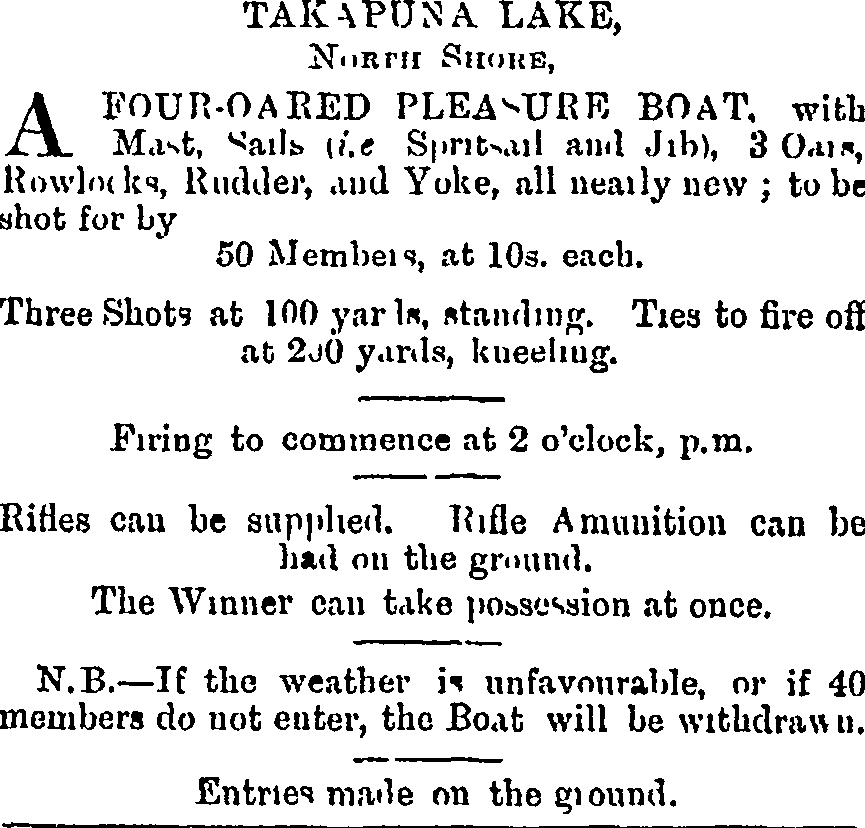
The North Shore specialised in festivities and special events during the 19th century. This popular destination for outings and day trips hosted a special Anniversary Day extravaganza every year. Action centred around Takapuna's Lake Pupuke. Ferry passengers arrived early and stayed late to make the most of a full programme.

Ibid


Crack shots competed at a rifle range for prizes, horse racing was on the cards, with fresh water racing on the Lake itself. In the evening the Grand Marquee on the Promenade provided an open air ball room.


Ibid


Takapuna Beach provided a perfect Harbour view of the main Regatta and was renowned for the relaxed and sociable atmosphere. Ferries came and went during the day with special night sailings for the last of the party goers making their way home.

This image shows the same occasion 35 years later in 1899. The Promenade was aptly named. AWN 3 Feb 1899

Our 21st century Auckland is a world away from our settlement days but we can still keep our heritage in mind.  If you are interested in celebrating our city's origins in 1840 the Maritime Museum has a full programme of activities on offer, including the opportunity to sail out on some restored colonial period craft. You find details of sailing times here. Other activites and events are highlighted here. Enjoy.


Monday, 9 October 2017

Exploring Heritage Matters


Auckland is into the second week of its Heritage Festival  now with plenty of events for enthusiasts of our built heritage. There is an overall theme of transportation in this year's festival but I noticed two events coming up of relevance to Bartley and Devonport researchers.

St Matthews in the City. Image Postcard Collection BFA

Peter Reed, architect, leads an exploration of St Matthews in the City next Saturday 14 October. Edward Bartley was supervising architect for this 1905 landmark as part of his role as architect to the Anglican Diocese of Auckland.
Tour details here
Information on the construction of St Matthews here

Torpedo Bay 1879 Image APLSGGSC4-2979

For those whose Auckland roots lie in Devonport there is an opportunity to tour the earliest sites of commercial activity. Details of the Maritime self guided tours on all week are here and information on the pioneer boatbuilders here
Edward Bartley's first home on the North Shore was on the foreshore at Devonport. He was a neighbour to William Holmes whose house and family feature in the promotional material for this event. Edward's eldest son Arthur married William's neice Polly Holmes

Holmes family home and boatyard about 1880. Image APL SSGSC

If you are going to Devonport by car please do visit O'Neill's Point cemetery and see Edward Bartley's grave restored. There are several other Bartley graves in the cemetery.

Judging by the response to our post Frank and Dorothy's project has inspired  other families to identify and care for family plots. Well there is good news. It has never been easier.

Bartley Archive holds some information on family graves, and a few photographs of plots. Do get in touch at the start if you have Bartley Channel Islands links. We may be able to help if other researcher's contributions included burial records.

The first step in fresh research is to obtain an 'address' for the plot. Many cemeteries now have an online database available to search. For example Auckland Council has access for burials and cremations in the region on this page

Image BFA 2014

Most of the larger public cemeteries have maps online or available at the office for the second step -which is locating the plot itself. On the basis of past experience I would recommend a party of two or more people, good walking shoes, good humour and an openess to synchronicity. Keep your ancestor in mind and your camera in hand-some of these places are very beautiful landscapes too.

Purewa Cemetery, St John's Auckland. Image BFA 2012


Saturday, 30 September 2017

Edward Bartley's Grave Restored


It is a great pleasure to be writing this post. On behalf of Edward's descendants we give a great bouquet of thanks to Frank and Dorothy Bartley who have undertaken and carried out the restoration of the Bartley gravesite at O'Neill's Point Cemetery, Devonport in Auckland.
With the site cleared Dorothy discusses the state of the headstone. Image F&D Bartley 2017

As visitors to the cemetery will know the plot was in a sad condition. Time and some vandalism during the late 20th century left us little to be proud of. Fortunately Frank and Dorothy were on hand in Auckland to closely oversee the project from the outset. The work was carried out by Steven Webb, of Monumental Headstones and Plaques Ltd,  who was able to salvage the marble and some surviving iron fittings.

Marble reinstated, remaining ironwork cleaned and returned to original placement, with work proceeding on re-erction of the headstone. Image S Webb 2017

The completed reinstatement and restoration of the gravesite September 2017. Image F&D Bartley 2017


Edward's wife Elizabeth Hannken also lies in this plot, along with their sons Percy and Claude  (husband of Cassie Tooher). Edward's daughter Bertha Bartley, wife of Frank Mason, lies nearby in the Mason family grave.
Frank Bartley stands with the reinstated headstone. The buff pink marble obelisk behind his shoulder is the Mason family plot where Bertha Bartley is interred. Image F&D Bartley 2017
Edward Bartley and Family Image BFA
Once again thank you Frank and Dorothy.

Friday, 16 June 2017

Captain Matthew Slattery of Tipperary - Part Two


We talked about Matthew Slattery and his early career in the previous post. Here we take up his story after the war in Northland, New Zealand.

Map of Kawiti's Pah Ruapekapeka 1846 Sir George Grey Special Collections, Auckland Libraries, NZ Map 4626

The 58th Regiment returned to Auckland after the final battle at Ruapekapeka on 11 January 1846, where they had met unexpectedly sophisticated trench warfare and significant casualties. The map gives only a sketch but the strong geographical position and layout give some indication of the defences they encountered that day.

In May 1846, Governor George Grey ordered a continent of the 58th to Wellington to act as deterrent in the wake of ongoing land disputes between new settlers and Ngāti Toa. They saw action in the Hutt Valley at Boulcott’s farm but Slattery was back in Auckland by the end of May. He married Mary Anne Pickford in June 1846. 2 It was a short window of opportunity – he was to be on board ship with his regiment at the end of the month, returning to Wellington.


NZ 27 June 1846


The 58th then returned to Paramatta, Sydney where the birth of Slattery’s first child Robert was registered on 17 April 1847. When the Regiment was again called to New Zealand the family returned to Auckland  on HMS Dido, arriving 1 July 1847.3  A second child named Matthew was born. Although his birth entry has not yet been found in NSW or Auckland, his death in 1848 records the age of 12 months. Robert also died later that year, recorded as just under 2 years, at 22 months.  Ann Eliza, the next child, was baptised in Auckland on 6 August 1848.4 (We shall take a closer look at the life and members of this growing family in a later post.)

Matthew was promoted to Corporal on 1 December 1847 and to Colour Sergeant in 1848. He remained with the 58th at Auckland for the next ten years. He was a property owner by 1853 and therefore able to vote in the contentious election of his commanding officer, Col Wynyard, to the position of Civil Superintendent.5 He enjoyed music, being accomplished on the clarinet. In addition to performances with the army band Matthew was active with the Choral Society and other groups. He gave time generously to the Mechanics' Institute as well, taking part in a series of lectures and concerts of British folk music.6


During these years the 58th took part in many public building works, particularly roading projects. Part of the Quartermaster's duties were the management of supplies, stores, ammunition, and property. 1858 was a busy time for Slattery, as regimental affairs were tidied up in preparation for their departure from New Zealand.

NZH 11 June 1858

Several hundred men took discharge in New Zealand at the time the Regiment left for England, but Matthew was only 34 and continued with his career, being promoted to Quarter Master in July 1858

NZH 10 Nov 1858


 His growing family travelled with him to Parkhurst on the Isle of Wight, where he served until 1862 as Quartermaster 5th Depot.


Embarkation list NZH 20 Nov 1858


Matthew’s Indian service began in June 1862 with the 38th Regiment, the 1st Staffordshire. He served with them as Quartermaster stationed in Sealkote, Benares (Varanasi) from 1863. This Northern cultural centre on the Ganges is often referred to as the ‘Athens of India’. It is considered the holiest of the seven sacred cities by Hindu, while holding special significance for all faiths in India. This city was the scene of an atrocious battle between British and Indian forces in the First Indian Rebellion – or War of Independence of 1857- 1858.

Samuel Bourne's image of Benares from across the Ganges c 1870


The outcome of the uprising was an end to the rule of the East India Company, as the British Crown took control. The British Raj was established in 1858 encompassing approximately 3/5th of the continent. Independent states such as Varanasi remained so, as allies of the Crown.

Harts Army List 1868 p 297 detailing Slattery's rank and background. (image NA)


 Pashwur, Bengal is known today as Peshawar, Pakistan. This North West region was Slattery’s posting to the garrison there in 1870. This was an area of long standing conflict between indigenous clans and invadors, not far from the famed Khyber Pass.

Khyber Pass Region map by wikimedia

The 38th returned to England for a spell during 1871 but contingents sailed again at the end of the year, arriving in Bombay by HMS Euphrates on 8 December.7 His family are not recorded as passengers. In the census of 1871 Mary Anne, Fanny (Frances) and Maude are listed attending a ladies college in Lambeth, London. This arrangement was traditional for families of servicemen in India.

 The regiment went back to England again in 1872  but Matthew returned to India in 1873 as Quartermaster with the 7th Royal Fusiliers 2nd Battalion, stationed with them in Poona (now known as Pune), Bombay 8.
Barracks were a little east of the city, in a large European compound. Matthew was accompanied this time by Mary Anne, 3 sons and 3 daughters. They were seasoned travellers by now and were returning to a busy Anglo-Indian centre of both military and administrative personnel. During monsoon season Poona was the centre of Bombay government administration.

In 1876 the Royals moved to Belgaum, Bombay where he remained until he retired on half pay as Honorary Captain on 25 May 1878.

Matthew Slattery is recorded as leaving India for Melbourne, Australia on 24 May 1878, embarking with his family on the P&O steamer SS Assam.9 He returned to New Zealand to live at Northcote, on Auckland's North Shore.
On 1 July 1881 he was listed as retired on full pay and was last mentioned in Hart’s Army List in 1904 as retired. He continued to take an active part in local affairs until his death in September 1904 at the age of 80.


[1] Times 7 Mar 1859 page 10
[2] St Patricks Cathedral Catholic Registers - Marriage: 30 June 1846, Auckland, Matthew Slattery, 58th Regiment, soldier, son of Robert Slattery and Eliza Champion, to Marianne Pykford, from Sommersetshire, England, daughter of Samuelis Picford and Anna Dexter
[3] ref New Zealander 3 July 1847
[4] St Patricks Cathedral Catholic Registers – Baptism: Ann Eliza, daughter of Matthew Slattery, Sergt, 58th Regiment, and Mary Ann Picford, baptised 6 August 1848. Date of birth not given.
[5] DSC 7 July 1853
[6] NZer 8 & 15 August 1857
[7] Times of India 8 Dec 1871 per fibis transcript
[8] Times of India 3 Nov 1873 per fibis transcript Portsmouth to Bombay arrived HMS Serapis 1 Nov      1873
[9] Times of India 25 May 1878 ibid