Showing posts with label devonport. Show all posts

Saturday, 27 January 2018

Auckland Anniversary Day

Welcome to a New Year and Auckland Anniversary weekend 2018.
Today we take a look at Auckland Anniversary celebrations from early in Auckland's history.
DSC 28 Jan 1864
 In the 19th Century Aucklanders joined with visitors in jostling for the best vantage points from which to view the races, just as we do today. They lined the shores on both sides of the harbour and established theselves with picnic gear, hats and binoculars. Those well practicsed in the art took their stand on a favourite headland or elevated verandah, such as Bastion Point and Mt Victoria - both well aspected for shade, viewing range and ventilation.

Our ancestors expected to make a day of it too. Extra licenses were issued for pop up stores selling snacks and meals, bars were open all day on both land and sea.

Looking over Queen's Wharf from the western side at the Regatta entrants on the Waitemata APL4-RIC-154


DSC28 Jan 1864


Ibid

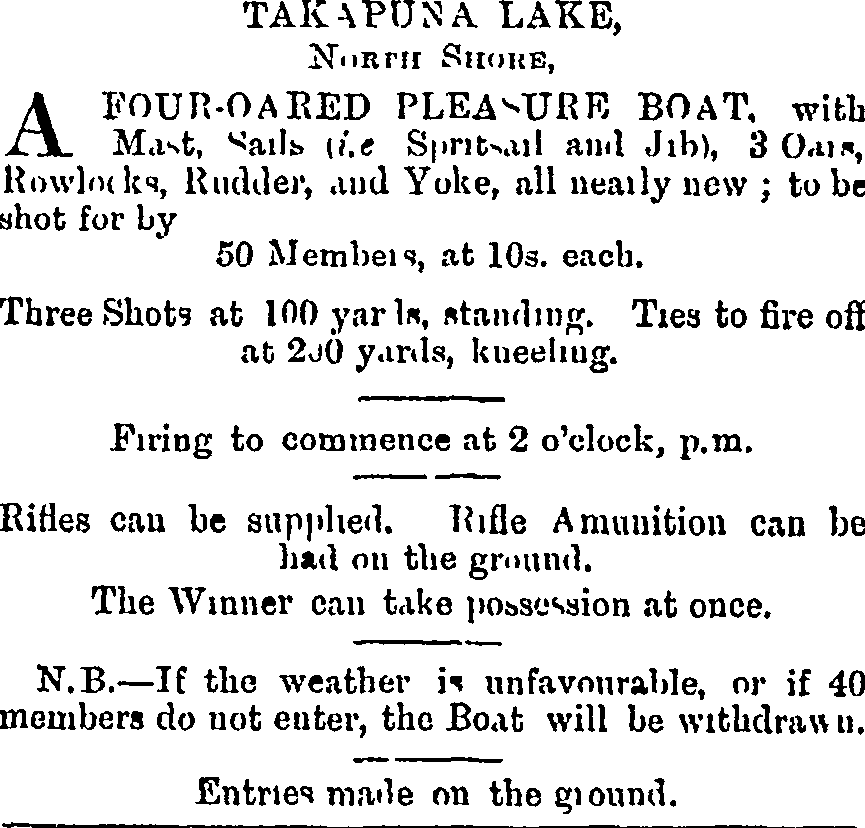
The North Shore specialised in festivities and special events during the 19th century. This popular destination for outings and day trips hosted a special Anniversary Day extravaganza every year. Action centred around Takapuna's Lake Pupuke. Ferry passengers arrived early and stayed late to make the most of a full programme.

Ibid


Crack shots competed at a rifle range for prizes, horse racing was on the cards, with fresh water racing on the Lake itself. In the evening the Grand Marquee on the Promenade provided an open air ball room.


Ibid


Takapuna Beach provided a perfect Harbour view of the main Regatta and was renowned for the relaxed and sociable atmosphere. Ferries came and went during the day with special night sailings for the last of the party goers making their way home.

This image shows the same occasion 35 years later in 1899. The Promenade was aptly named. AWN 3 Feb 1899

Our 21st century Auckland is a world away from our settlement days but we can still keep our heritage in mind.  If you are interested in celebrating our city's origins in 1840 the Maritime Museum has a full programme of activities on offer, including the opportunity to sail out on some restored colonial period craft. You find details of sailing times here. Other activites and events are highlighted here. Enjoy.


Monday, 9 October 2017

Exploring Heritage Matters


Auckland is into the second week of its Heritage Festival  now with plenty of events for enthusiasts of our built heritage. There is an overall theme of transportation in this year's festival but I noticed two events coming up of relevance to Bartley and Devonport researchers.

St Matthews in the City. Image Postcard Collection BFA

Peter Reed, architect, leads an exploration of St Matthews in the City next Saturday 14 October. Edward Bartley was supervising architect for this 1905 landmark as part of his role as architect to the Anglican Diocese of Auckland.
Tour details here
Information on the construction of St Matthews here

Torpedo Bay 1879 Image APLSGGSC4-2979

For those whose Auckland roots lie in Devonport there is an opportunity to tour the earliest sites of commercial activity. Details of the Maritime self guided tours on all week are here and information on the pioneer boatbuilders here
Edward Bartley's first home on the North Shore was on the foreshore at Devonport. He was a neighbour to William Holmes whose house and family feature in the promotional material for this event. Edward's eldest son Arthur married William's neice Polly Holmes

Holmes family home and boatyard about 1880. Image APL SSGSC

If you are going to Devonport by car please do visit O'Neill's Point cemetery and see Edward Bartley's grave restored. There are several other Bartley graves in the cemetery.

Judging by the response to our post Frank and Dorothy's project has inspired  other families to identify and care for family plots. Well there is good news. It has never been easier.

Bartley Archive holds some information on family graves, and a few photographs of plots. Do get in touch at the start if you have Bartley Channel Islands links. We may be able to help if other researcher's contributions included burial records.

The first step in fresh research is to obtain an 'address' for the plot. Many cemeteries now have an online database available to search. For example Auckland Council has access for burials and cremations in the region on this page

Image BFA 2014

Most of the larger public cemeteries have maps online or available at the office for the second step -which is locating the plot itself. On the basis of past experience I would recommend a party of two or more people, good walking shoes, good humour and an openess to synchronicity. Keep your ancestor in mind and your camera in hand-some of these places are very beautiful landscapes too.

Purewa Cemetery, St John's Auckland. Image BFA 2012


Saturday, 30 September 2017

Edward Bartley's Grave Restored


It is a great pleasure to be writing this post. On behalf of Edward's descendants we give a great bouquet of thanks to Frank and Dorothy Bartley who have undertaken and carried out the restoration of the Bartley gravesite at O'Neill's Point Cemetery, Devonport in Auckland.
With the site cleared Dorothy discusses the state of the headstone. Image F&D Bartley 2017

As visitors to the cemetery will know the plot was in a sad condition. Time and some vandalism during the late 20th century left us little to be proud of. Fortunately Frank and Dorothy were on hand in Auckland to closely oversee the project from the outset. The work was carried out by Steven Webb, of Monumental Headstones and Plaques Ltd,  who was able to salvage the marble and some surviving iron fittings.

Marble reinstated, remaining ironwork cleaned and returned to original placement, with work proceeding on re-erction of the headstone. Image S Webb 2017

The completed reinstatement and restoration of the gravesite September 2017. Image F&D Bartley 2017


Edward's wife Elizabeth Hannken also lies in this plot, along with their sons Percy and Claude  (husband of Cassie Tooher). Edward's daughter Bertha Bartley, wife of Frank Mason, lies nearby in the Mason family grave.
Frank Bartley stands with the reinstated headstone. The buff pink marble obelisk behind his shoulder is the Mason family plot where Bertha Bartley is interred. Image F&D Bartley 2017
Edward Bartley and Family Image BFA
Once again thank you Frank and Dorothy.

Saturday, 18 June 2016

Edward Bartley and the Stark Commission 1886


The Devonport district is a unique environment in the Auckland area. The continued presence of the armed forces is intrinsic to its character. In the early days of settlement that presence was concerned with establishing colonial life, with internal affairs. In the latter part of the nineteenth century developments in the Crimean conflict turned attention to the question of our defence against external threats.
In 1885 Russian troops occupied Afghanistan. This event brought the impact of Britain’s international affairs much closer to the Southern Hemisphere. If British India was so vulnerable then New Zealand was too.

Colonial government took steps to firm up defence plans which had been formed in the 1870s around a harbour defence system. For Auckland this meant protecting the gap between North Head and Britomart Point.
This clear view of the relationship of Narrow Neck (centre) to Auckland central shows the reasons why it was intrinsic to port security.
Winkelman Image about 1900 SGGSC W00197 APL

It meant a modern defence base, provision for storage and deployment of mines. It also meant visible, state of the art fire power on a prominent headland.

To see how these concerns brought Devonport in to the limelight we take a glance back to the early 1880s. A gentleman by the name of Robert Adam Mozeley Stark owned a good sized property at North Head which he named ‘Fair Cliff’. Of Scottish extraction he was a member of the Takapuna Jockey Club, one of the directors of the Devonport and Takapuna Tramway company, and a friend and business associate of Alex Alison. He was also a likely candidate for the Waitemata seat in the next election.
In 1881 Stark put part of his 32 acre property on the market after a short tenure there. Despite the best efforts of his estate agent a conditional sale in 1884 for £3500 sale remained uncompleted. Stark then withdrew Fair Cliff from the market.
In March 1886 the press reported the sale of Stark's land to the Crown for defence purposes. The purchase price was almost six times the 1884 list price. The Auckland Star's assertion that 'public curiosity' was aroused was a mild reference to the outcry which followed.1 Accusations of 'secret transactions' were widespread. When Parliament resumed a commission of inquiry called for. Meanwhile Mr Stark had taken the opportunity to travel abroad. He was contacted by his solicitors to return to Auckland and attend the proceedings which began 11 October 1886.2

As expected Devonport was rife with accusation and speculation, even more so that the rest of the country. Stark's neighbours were astonished by his success in attracting a price so far above the depressed values of previous years. The factional rivalries which had their roots in the earliest days of the settlement again came into view.
Edward Bartley was amongst those who had agitated most strongly for enquiry into due process around the sale. His name also appeared on the petition - with just under 1000 other names -sent to parliament requesting a commission be appointed. From the outset Commissioners sat and heard accusations of unethical practice around land dealing at the North Shore, but no evidence was supplied as proof that this had occurred in connection with the Government purchase of Stark's block.  Alex Alison's name was associated with the 'bidding by interested parties' on land sales - the inference being that prices were artificially inflated. In this context the development around Stark's land at Cheltenham was referenced.

An example of the type of development drawn to the attention of the Commission. These residential blocks were offered for sale in January 1885 (AS 2 Jan 1885)


By mid October the knives were out. Devonport was the focus of national attention by that time. Edward Bartley was called to give evidence on the 21st of October. Alex Alison then took the offensive against Bartley, William Philcox and those who had requested the official enquiry.
NZH 22 Oct 1886
In fact Edward Bartley was well placed to give evidence as he had been employed as Stark's architect on various subdivisions on the North Shore, as well as for Stark's own home. He was able to testify as to his client's intentions as they had been conveyed to him at the time a portion of the land was first offered for sale in 1883, which was to subdivide it. He further testified that, rather than being motivated by ill will, he had sought to have the matter clarified publicly.

The Commissioner's final report found no evidence of misconduct. Development of defence facilities at North Head were put in place and the presence in Devonport of armed services has continued down to the present day. For the civilian population, however, the residue of ill will left by the whole proceeding meant that personality conflict continued to mar local politics for some time to come.

1. Auckland Star 6 March 1886
2. Ibid 16 Oct 1886 
Report of the Stark Commission can be found here

Monday, 21 December 2015

Summer Holiday


Thank you everyone for your support during the year. Hope you enjoy this visual celebration of the New Zealand Summer. Have a wonderful holiday season and travel safe


Festive Entertainment advertised Auckland Star 23 December 1876

The Auckland Photographic Club Summer excursion at Auckland Domain. Possibly Fred Bartley seated 3rd from left. Undated Image BFA


Auck Star 21 Dec 1876

The family of Robert and Esther Bartley at Taupaki early 1900s. Donated Image BFA
Cheltenham Beach, interwar years. Image by George Bartley BFA

Crozier family picnic Southland early 1900s Image Harry Crozier BFA

Takapuna Beach January 1906 Image SGGSC A256


Sunday, 29 November 2015

Pioneer Boat Builders in Devonport


Looking across Torpedo Bay to the Masonic Hotel, 1879. Image SGGSC APL 4-2979

When we visit Devonport in Auckland today it is hard to visualise it as a vital centre of industry, but it was. The 1850’s through to the late 1880’s were a peak time for ship building. Devonport was a major hub for this boom in maritime construction and the associated trade services. This post looks at three of the earliest ship yards in Devonport with a focus on community and connections.

Torpedo Bay was the area where the bulk of early boat building was carried out. Alex Alison was one of the first to set up a boat building yard in Devonport. He purchased property on the foreshore. King Edward Parade follows his seaward boundary, which extended to just east of where the Masonic Tavern was to be built.

Torpedo Bay Devonport about 1870 Image BFA

The Alison home was one of the earliest wooden dwellings in Devonport. At that time the area was characterised by Maori settlement with only a few scattered settler farms. About 1854 he moved his boat building operation from Official Bay across to Devonport.
At Torpedo Bay he continued to specialise in smaller craft which he built for sale, rather than the more conventional practice of building to order.

DSC 27 Jan 1854


 Alison's ‘Foam’ was a clinker built copper fastened boat launched 2 April 1855 whose construction included some of Duder Bros cement between skins. Could that be a first in New Zealand boat building? She made a good showing in the Auckland Anniversary regattas.

DSC 30 Jan 1857


 His sons Alex and Ewen, in particular, left an indelible mark on Devonport and Takapuna. Their involvement in local politics, racing, ferry services is legendary on the North Shore. The pioneering contribution of the Alisons is remembered in the clock tower at the base of Victoria Rd. Alex’s grandson Ewen later married Freda Bartley, daughter of Clement.

George Beddoes set up his boat building yard at the North Head end of Torpedo Bay in the late 1850’s, until his remove to Fiji around 1872, in the midst of a Supreme Court Appeal concerning the Devonport wharf.
 Alex Alison’s son Ewen was apprenticed to him. For a short while he was in partnership with John Holmes, who came to New Zealand via Melbourne. Later he moved further along the Bay to build a slip near where the Rowing Club is based. Beddoes’ yard is credited with building the first composite iron and wood vessel constructed in Auckland. This was the ferry ‘Devonport’ launched in 1870.

 John Holmes was soon joined by his brothers James and William when fundamental differences led to the partnership with Beddoes being dissolved.
Holmes Bros, as their business became known, built a slip at the bottom of Victoria Road near the landing reserve, where the wharf buildings are today. There the first North Shore built steam ferry – the ‘Waitemata’- was constructed. Their first ferry services company Waitemata Steam Ferry Company did not prosper and folded in 1867. The steamer was transferred to a new company- the North Shore Steam Ferry Company and renamed.

The remodelled 'Waitemata' renamed 'Enterprise II' constructed 1865 Image SGGSC APL

Another Holmes Bros paddle steamer 'Enterprise 1' Image SGGSC APL c 1867


Like the Bartley’s, the Holmes family came from St Helier, Jersey. After leaving the Channel Islands, their family moved to Sunderland, England and Australia. In Auckland they were able to re-establish their close connection with the Bartley brothers, Robert and Edward, who had moved to New Zealand in 1854.
John Holmes daughter Polly (Mary Elisabeth) married Arthur Bartley, son of Edward.
The family home of William Holmes on the foreshore at Devponport. Image SGGSC APL c1880

There was close cooperation between these early settlers at Devonport, but they were also highly competitive. Not only Anniversary Day Regattas were fiercely contested. Competition to control North Shore ferry services was cut throat, particularly between the Holmes brothers and the Alisons. Disputes arose as to the best placement of passenger facilities and various other commercial concerns. Local body affairs were sometimes coloured by the factions formed around business these concerns. The 1870 dispute over Alex Alison’s shoreline wall is one example. It took nearly twenty years and the Supreme Court to resolve this issue.

Conversely, it was that same single minded commitment and investment which led to the rapid development of the district. Improvement in ferry services was a key factor in opening up the North Shore for residential settlement. Edward Bartley was just one who delayed his move across the harbour from Auckland until 1870. Anyone with business interests in Auckland required a reliable commuter service. Anyone producing goods and services on the Shore for Auckland markets was equally dependent on steady freight services.
The personalities, prosperity and development associated with the boat building industry contributed immeasurably to the development of Devonport in social as well as economic terms.

Wednesday, 4 November 2015

Edward Bartley & Holy Trinity, Devonport, Auckland


The Anglican Church of Holy Trinity was constructed in 1865.  The congregation more than doubled during the next ten years. This phenomenon was general to the district. The population of Devonport increased during the 1870's to just under 1000 residents. The pressure to enlarge facilities was felt by all religious and social organisations in the community.

A decision was made in 1874 to enlarge the existing church by extending the nave and aisles by 9 feet. Edward Bartley prepared the plans which were executed by Henry Pitts. At this time Edward was still operating predominantly as a master builder. By 1877 when a meeting of the Vestry agreed that a larger church was urgently required, it was Edward Bartley, now a practising architect, who was asked to draw plans for a new church. It is likely that his later appointment as Diocesan Architect was facilitated by this early involvement with Holy Trinity.

It was another three years before these plans for the church were accepted as real financial constraints dictated the pace of development. There were other calls on any money available for building. Funds were needed to purchase the house being rented and used as a parsonage. The Sunday School was also seriously overcrowded. 

All these projects relied on subscriptions and donations from the community. Over £400 was found to buy the parsonage and extend the school room during 1878. At the same time residents were being called on to support other community projects for education and arts facilities, meeting spaces and infrastructure. Consider how this level of commitment by the community compares to the average rate of charitable donation today. 


The Programme for one of several fundraising concerts organised by Alf Bartley with his father Edward in 1886.
 Image BFA 2003

The whole community rallied around to support the project with a number of entertainments and fetes.  One of the most successful event was a week long Egyptian Fair held in 1886. The drill shed at Devonport was transformed into the ancient East.
Edward Bartley worked with his son Alfred to design the stalls as stage sets. He had the professional assistance of his nephew Theo Queree, a recent Jersey immigrant who was particularly skilled in operatic stage design. Devonport resident H. N. Williams provided his considerable artistic flair and the benefit of his extensive travels in the Middle East. Visitors entered the Temples of Isis and Osiris, passed between columns and past friezes faithfully imitating the ancient style. The triumph at the eastern end of the stall was a desert sunset. Purchasers responded generously, delighted to buy fancy work and preserves from the matrons and young ladies suitably attired in a chastely Victorian version of Egyptian costume.

During 1884 the parsonage property was sold at a profit and Edward was asked to design a new vicarage within the £600 realised. £860 was required to construct the chancel and transepts of the new church, which was builder William Philcox's lowest tender.  The temporary sections were to be plain, functional and cheap. New building began at eastern end of the old church, which served as the nave in the meantime. 

The temporary solution for Holy Trinity 1883 Image APL SGGSC

The next stage was erected over the old building during 1886. This old church was  taken away and reconstructed on a section behind the new one. There were still plans to add a further ten feet to the front of the new church, along with a tower, spire and south porch.

 View of Holy Trinity, Devonport and surrounds, showing the new church with the old on an adjacent section c 1887. Image BFA
 From the south window, with its elaborate gothic tracery, to the joinery of the seats and fittings, this Church fills with soft light and texture- a celebration of wood and worship. 
Interior view, Holy Trinity, Devonport, Auckland. Image BFA 2003
All of the fittings were supplied by the congregation. Edward designed a new pulpit in native timbers to complement the interior, which was placed in the Church in time for its completion.

Pulpit Holy Trinity, Devonport, Edward Bartley. Image APL SGGSC 5896
No asset or effort was wasted. The Sunday School had again outgrown the space available so the schoolroom was hoisted onto skids and moved down to be joined to the old church.
The next building project proceeded immediately with the construction of the new Vicarage in 1887. There was then a pause until the new hall was built in 1910. This was financed by a mortgage. Edward Bartley, along with Humphrey Duder and George Hunt were appointed trustees for the property until it became debt free. 

A 1929 view showing the vicarge in the centre and the hall to the left. A glimpse of the church can be seen on the right. Image Sir George Grey Special Collections, Auckland Libraries, 4-5899

Edward died in 1919 and Duder in 1927, after which the property was vested in the Diocese, marking an end to the establishment phase for Holy Trinity. Plans for the third and final phase of building the tower and spire and south porch were never realised. 
Image BFA 2003


Saturday, 4 April 2015

Saturday, 28 March 2015

Auckland Savings Bank in Devonport - Edward Bartley


Front Elevation ASB Devonport

I hope readers will enjoy this set of plans for an ASB branch building, now demolished. 
The original site was on Victoria Road, Devonport, Auckland almost opposite the council chambers.

Edward Bartley had to wait until the end of his career to design a bank building for his home suburb of Devonport, on the North Shore of Auckland. 
Local residents were forced to petition and lobby in order to get a branch at all, coming in well behind Onehunga, Newmarket and Surrey Hills. Building began in Devonport in 1901.

At this time it was still traditional for the manager to live on the premises. It may seem strange to us now, but a practical set of apartments was an important aspect of the design of bank buildings.
At Devonport the ground floor of this brick building was divided into banking room, dining room and kitchen, with a connecting hall and side door. On the first floor four bedrooms supplied the sleeping accommodation.

Back Elevation ASB Devonport


First Floor Plan showing Manager's Accommodation

Cross Section ASB Devonport
Fortunately a good number of the heritage buildings along Victoria Road are still used and maintained today. There is a special ambience to Devonport which greets the ferry traveller from central Auckland. Everything seems to slow down to the more leisurely pace of a gentler time. No bad thing is it?
Street frontages of heritage buildings on Victoria Rd Devonport. Image BFA