Showing posts with label philcox. Show all posts

Saturday, 18 June 2016

Edward Bartley and the Stark Commission 1886


The Devonport district is a unique environment in the Auckland area. The continued presence of the armed forces is intrinsic to its character. In the early days of settlement that presence was concerned with establishing colonial life, with internal affairs. In the latter part of the nineteenth century developments in the Crimean conflict turned attention to the question of our defence against external threats.
In 1885 Russian troops occupied Afghanistan. This event brought the impact of Britain’s international affairs much closer to the Southern Hemisphere. If British India was so vulnerable then New Zealand was too.

Colonial government took steps to firm up defence plans which had been formed in the 1870s around a harbour defence system. For Auckland this meant protecting the gap between North Head and Britomart Point.
This clear view of the relationship of Narrow Neck (centre) to Auckland central shows the reasons why it was intrinsic to port security.
Winkelman Image about 1900 SGGSC W00197 APL

It meant a modern defence base, provision for storage and deployment of mines. It also meant visible, state of the art fire power on a prominent headland.

To see how these concerns brought Devonport in to the limelight we take a glance back to the early 1880s. A gentleman by the name of Robert Adam Mozeley Stark owned a good sized property at North Head which he named ‘Fair Cliff’. Of Scottish extraction he was a member of the Takapuna Jockey Club, one of the directors of the Devonport and Takapuna Tramway company, and a friend and business associate of Alex Alison. He was also a likely candidate for the Waitemata seat in the next election.
In 1881 Stark put part of his 32 acre property on the market after a short tenure there. Despite the best efforts of his estate agent a conditional sale in 1884 for £3500 sale remained uncompleted. Stark then withdrew Fair Cliff from the market.
In March 1886 the press reported the sale of Stark's land to the Crown for defence purposes. The purchase price was almost six times the 1884 list price. The Auckland Star's assertion that 'public curiosity' was aroused was a mild reference to the outcry which followed.1 Accusations of 'secret transactions' were widespread. When Parliament resumed a commission of inquiry called for. Meanwhile Mr Stark had taken the opportunity to travel abroad. He was contacted by his solicitors to return to Auckland and attend the proceedings which began 11 October 1886.2

As expected Devonport was rife with accusation and speculation, even more so that the rest of the country. Stark's neighbours were astonished by his success in attracting a price so far above the depressed values of previous years. The factional rivalries which had their roots in the earliest days of the settlement again came into view.
Edward Bartley was amongst those who had agitated most strongly for enquiry into due process around the sale. His name also appeared on the petition - with just under 1000 other names -sent to parliament requesting a commission be appointed. From the outset Commissioners sat and heard accusations of unethical practice around land dealing at the North Shore, but no evidence was supplied as proof that this had occurred in connection with the Government purchase of Stark's block.  Alex Alison's name was associated with the 'bidding by interested parties' on land sales - the inference being that prices were artificially inflated. In this context the development around Stark's land at Cheltenham was referenced.

An example of the type of development drawn to the attention of the Commission. These residential blocks were offered for sale in January 1885 (AS 2 Jan 1885)


By mid October the knives were out. Devonport was the focus of national attention by that time. Edward Bartley was called to give evidence on the 21st of October. Alex Alison then took the offensive against Bartley, William Philcox and those who had requested the official enquiry.
NZH 22 Oct 1886
In fact Edward Bartley was well placed to give evidence as he had been employed as Stark's architect on various subdivisions on the North Shore, as well as for Stark's own home. He was able to testify as to his client's intentions as they had been conveyed to him at the time a portion of the land was first offered for sale in 1883, which was to subdivide it. He further testified that, rather than being motivated by ill will, he had sought to have the matter clarified publicly.

The Commissioner's final report found no evidence of misconduct. Development of defence facilities at North Head were put in place and the presence in Devonport of armed services has continued down to the present day. For the civilian population, however, the residue of ill will left by the whole proceeding meant that personality conflict continued to mar local politics for some time to come.

1. Auckland Star 6 March 1886
2. Ibid 16 Oct 1886 
Report of the Stark Commission can be found here

Wednesday, 4 November 2015

Edward Bartley & Holy Trinity, Devonport, Auckland


The Anglican Church of Holy Trinity was constructed in 1865.  The congregation more than doubled during the next ten years. This phenomenon was general to the district. The population of Devonport increased during the 1870's to just under 1000 residents. The pressure to enlarge facilities was felt by all religious and social organisations in the community.

A decision was made in 1874 to enlarge the existing church by extending the nave and aisles by 9 feet. Edward Bartley prepared the plans which were executed by Henry Pitts. At this time Edward was still operating predominantly as a master builder. By 1877 when a meeting of the Vestry agreed that a larger church was urgently required, it was Edward Bartley, now a practising architect, who was asked to draw plans for a new church. It is likely that his later appointment as Diocesan Architect was facilitated by this early involvement with Holy Trinity.

It was another three years before these plans for the church were accepted as real financial constraints dictated the pace of development. There were other calls on any money available for building. Funds were needed to purchase the house being rented and used as a parsonage. The Sunday School was also seriously overcrowded. 

All these projects relied on subscriptions and donations from the community. Over £400 was found to buy the parsonage and extend the school room during 1878. At the same time residents were being called on to support other community projects for education and arts facilities, meeting spaces and infrastructure. Consider how this level of commitment by the community compares to the average rate of charitable donation today. 


The Programme for one of several fundraising concerts organised by Alf Bartley with his father Edward in 1886.
 Image BFA 2003

The whole community rallied around to support the project with a number of entertainments and fetes.  One of the most successful event was a week long Egyptian Fair held in 1886. The drill shed at Devonport was transformed into the ancient East.
Edward Bartley worked with his son Alfred to design the stalls as stage sets. He had the professional assistance of his nephew Theo Queree, a recent Jersey immigrant who was particularly skilled in operatic stage design. Devonport resident H. N. Williams provided his considerable artistic flair and the benefit of his extensive travels in the Middle East. Visitors entered the Temples of Isis and Osiris, passed between columns and past friezes faithfully imitating the ancient style. The triumph at the eastern end of the stall was a desert sunset. Purchasers responded generously, delighted to buy fancy work and preserves from the matrons and young ladies suitably attired in a chastely Victorian version of Egyptian costume.

During 1884 the parsonage property was sold at a profit and Edward was asked to design a new vicarage within the £600 realised. £860 was required to construct the chancel and transepts of the new church, which was builder William Philcox's lowest tender.  The temporary sections were to be plain, functional and cheap. New building began at eastern end of the old church, which served as the nave in the meantime. 

The temporary solution for Holy Trinity 1883 Image APL SGGSC

The next stage was erected over the old building during 1886. This old church was  taken away and reconstructed on a section behind the new one. There were still plans to add a further ten feet to the front of the new church, along with a tower, spire and south porch.

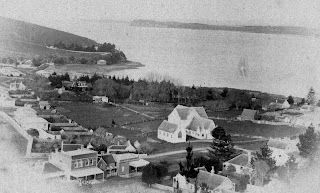
 View of Holy Trinity, Devonport and surrounds, showing the new church with the old on an adjacent section c 1887. Image BFA
 From the south window, with its elaborate gothic tracery, to the joinery of the seats and fittings, this Church fills with soft light and texture- a celebration of wood and worship. 
Interior view, Holy Trinity, Devonport, Auckland. Image BFA 2003
All of the fittings were supplied by the congregation. Edward designed a new pulpit in native timbers to complement the interior, which was placed in the Church in time for its completion.

Pulpit Holy Trinity, Devonport, Edward Bartley. Image APL SGGSC 5896
No asset or effort was wasted. The Sunday School had again outgrown the space available so the schoolroom was hoisted onto skids and moved down to be joined to the old church.
The next building project proceeded immediately with the construction of the new Vicarage in 1887. There was then a pause until the new hall was built in 1910. This was financed by a mortgage. Edward Bartley, along with Humphrey Duder and George Hunt were appointed trustees for the property until it became debt free. 

A 1929 view showing the vicarge in the centre and the hall to the left. A glimpse of the church can be seen on the right. Image Sir George Grey Special Collections, Auckland Libraries, 4-5899

Edward died in 1919 and Duder in 1927, after which the property was vested in the Diocese, marking an end to the establishment phase for Holy Trinity. Plans for the third and final phase of building the tower and spire and south porch were never realised. 
Image BFA 2003


Friday, 29 November 2013

Alfred Martin Bartley 1866-1929

Alfred Bartley, Steven Album, Bartley Archive


Alfred was the third child of Edward BARTLEY and Elizabeth HANNKEN. He was born at Union St Auckland 24 January 1866[1] and his early schooling was at Devonport School. He and Frederick were close companions. Alf was an exceptional musician, with a particular strength in keyboard performance, although he also played string instruments with great facility.
He often appeared at the City Hall as accompanist to visiting musicians. His work with the child prodigy Celia DAMPIER was particularly admired.

Observer 25 July 1891 p 14

In the  1880s Fred, Alf and Bertha Bartley performed regularly as a musical trio. Sport, music and social activity characterised the flourishing Devonport community at this time, just as it does today. One such example is the vibrant culture of the tennis club.  The names mentioned in these newspaper extracts include Alfred's relatives: Queree, Philcox, Mouzer and Mason for example. 
Alf also served as secretary of this Club in the 1890's. 


Observer 30 April 1887

Observer 6 July 1895

Apart from his personal performances Alf was involved with numerous musical groups as accompanist, trainer or organiser - including the Waitemata Minstrels and the Savage Club. His father Edward was a founder of the Orpheus Club and Alf joined him in that group, first as a singer and later as choir master.

Cover page of the Photograph Album presented by the Waitemata Minstrels, Steven Family Collection 

Alf appears in the centre, in civvies. This photo is unidentified and undated. Any information identifying the subject band would be highly appreciated.

Auckland Star 14 July 1922 Jazz age music after the war
Alfred served with the local Borough Council after the war years. He was also a force behind the resurgence of croquet in Devonport in the 1920s:


 Alf was not so happy in his working life. His natural inclination was to a musical career, but the economic reality dictated otherwise. He trained as a draughtsman and worked with various firms in Auckland until the depression of the 1890s when he was out of work.[2] His father gave him what work he could, but both he and Alf were aware that there was insufficient new building to support another a full wage from the architectural practice.

The engagement between Alfred and Miss Essie GRATTAN was announced in July 1890, with those of his brother and sister.[3] Essie was the only daughter of Richard Grattan, and once diagnosed with Bright’s disease, shortly after her engagement, her health deteriorated rapidly. 
Fred and Alfred both had their career prospects  curtailed by depression, an experience shared by many of their generation.
The brothers went to Australia, planning to join the mineral boom in Queensland, but Alfred returned home to New Zealand within a few months. 
Neither of the brothers had found immediate employment overseas and Essie's illness now became obvious and critical. He returned to Devonport.

The Archive holds on file an undated letter from Alfred’s mother Elizabeth. She is writing to Fred in Australia, sharing family news. In it she remarks on Alfred’s situation:
 I think Alf has given up all ideas of getting married. Essie is still very poorly and 4 Doctors tell the same tale that she can't live long although she is usually bright. Sometimes she doesnt know she is bad and talks to Alf about getting married. It is something awful for both. The Doctor thinks if she knew she would give up altogether so they dare not tell her.

Essie died 10 April 1894.[4]
 
Auckland Star 11 April 1894


Once Fred died, in June 1899, in Australia there seems to have been a change. From this time onwards Alfred appeared to be groomed to take over his father’s practice, eventually being made a partner in Bartley & sons, Architects.
 Alfred, however, never shared his father’s passion for architecture and after Edward died Alf left the partnership to their young partner Keith Draffin.

At the New Plymouth in February 1906 Alfred married Marianne Houghton Warren. She was born in Wagga Wagga, Australia 17 Feb 1883. She attended school in Hawera before coming to Auckland to train in nursing at the Mater Hospital in Epsom. [5]

Employment took a new turn, as the twentieth century began. Alfred began a new career as a land agent with Cowpermore-Jones.  He also worked with Hancock and Co around the time of the lifting of Prohibition. Hotels, previously run as boarding houses were undergoing conversion back to licensed premises. He travelled widely supervising alterations to his plans.[6]

Alfred died in Pentlands Hospital, Devonport on 1 May 1926. He is interred at O’Neill’s Point Cemetery.[7]


[1] Daily Southern Cross 28 February 1866 page 7
[2] Electoral Roll 1883 Eden. Resident Devonport Draughtsman. 1889 witness at wedding of cousin Ernest Queree, occupation draughtsman. Cert on file.
[3] Observer 26 July 1890
[4] NZRBDM 1894/2585
[5] Steven Family research
[6] Steven family research
[7] Probate 323/29. Burial May 1929 Cemetery Records O’Neill’s Point