Friday, 19 February 2016

New Flight Information


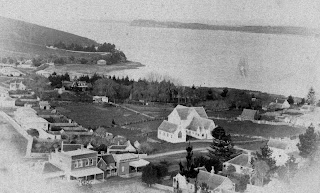
Royal Square St Helier,  an extract from the Ouless Album on file BFA


We have some exciting new research results to share today.
For the last few months I have been looking to clarify the information transcribed from the Bartley headstone Plot 180 at Green St Cemetery, Jersey. This work was done for us in the late 1980s by CIFHS volunteers. They did a marvellous job with what was then operating as a postal request service. The headstone was very weathered on the seaward side even then and no photograph was supplied. All the same, some valuable information was collected.
In places the volunteers had to make educated guesses. In particular the entries for Judith Caplain and Ann Flight were obscure. I am happy to say we can now clear up some of the confusion and add to our family story.

Anne Flight is recorded as wife of William Bartley, which she was. They married on 22 April 1797 at St Peter Port, Guernsey. What happened next goes a long way to explaining that confusing headstone. William Bartley died some time between 1801 and 1806. This was war time and it is likely he was involved in some way. His death record has not yet been found.

Widowed Anne remarried in 1806 to Nicolas Le Cappelain. We now know their daughter Judith Nancy Le Cappelain is the lady also mentioned in the transcript. Her name is anglicised to Caplain.
It took some time to find Judith’s marriage. Her husband was not a Bartley, as the transcribers had guessed. Judith married one Robert BAKER, who was from St Austell, Cornwall.
Judith was not found in the 1841 census of the Channel Islands and nor was Robert. We are not certain where she was living before her death in December 1845. She was buried with her mother and step family so it is possible she was herself widowed by this time.

That is not the end of the story concerning Anne Flight though. We had her date of death from the transcription which suggested that she had died in St Helier. That seemed likely but I could find no trace of her in the burial records of any Jersey parish. I had no luck finding her testament or probate in British or Jersey courts. Where was she? In desperation I widened my search to include court reports of all kinds held at Jersey Archives. There I found something astonishing.

 In September 1836 one John Hemmett was prosecuted for the mistreatment of his wife Ann Flight. The documents concerning the prosecution are not publicly available, so I am not able to publish the scan supplied. We can, however, paraphrase from my amateur translation:
On the night of 24 to 25 August 1836 Hemmett returned home late. His wife was asleep in bed but he attacked her ‘with violent force’. During the attack her jaw was broken and other injuries sustained. A neighbour raised the alarm and he was arrested by the constable. It is likely that this incident was a culmination of a repeating pattern, as guilt was admitted on appearance at court on September 3.

The outcome was a separation.  In essence the Court ordered Hemmett to surrender his wife’s possessions in the presence of a constable, to pay a financial compensation and to leave her alone. The financial and legal ramifications of any failure to observe the terms of this non-molestation order were clearly delineated. (Ref JA D/Y/G1/10/274)
Anne died 2 years after this incident. A return to the burial records of St Helier found her entry, the expected 5 days after the death date recorded at the cemetery. Given the circumstances it is no wonder her son Robert saw to it that she was interred at their family plot under his father’s name.

Here is a summary of our information about Anne and Judith:
Anne FLIGHT born 13 Jan 1775 child of Thomas FLIGHT and Anne ROBERT, was baptised at town church St Peter Port Guernsey, Channel Islands on 15 January 1775. (ref. IGI B7133719 50. Film sighted 11/97). She died 17 December 1838 aged 63 and was buried 22 December 1838 at Green St Cemetery St Helier. (Ref Parish Record Index 22 Dec 1838 Ann Hemmett – original not sighted).
At age 22 Anne married William BARTLEY, son of John of St Austell, Cornwall (IGI 7132323). William died before 1806.  There were two sons Robert John (1798) and William James (1801). It is possible there was also a daughter Betsy born about 1804.
Anne married Nicholas LE CAPPELAIN (CAPLAIN) when she was 31, 0n 23 April 1806 at St Peter Port. (IGI index only sighted 2010.) Their daughter Judith Nancy Le Cappelain was born about 1807 at St Peter Port, Guernsey. Judith married Robert BAKER at the town church in St Helier, Jersey. (Parish record index states ‘Capelain’. Robert was from St Austell.
Judith died on 19 December 1845 and was interred in the Bartley plot 180, Green St Cemetery.

Some time before 1836 Anne married John HEMMETT. They separated in September 1836.

Monday, 21 December 2015

Summer Holiday


Thank you everyone for your support during the year. Hope you enjoy this visual celebration of the New Zealand Summer. Have a wonderful holiday season and travel safe


Festive Entertainment advertised Auckland Star 23 December 1876

The Auckland Photographic Club Summer excursion at Auckland Domain. Possibly Fred Bartley seated 3rd from left. Undated Image BFA


Auck Star 21 Dec 1876

The family of Robert and Esther Bartley at Taupaki early 1900s. Donated Image BFA
Cheltenham Beach, interwar years. Image by George Bartley BFA

Crozier family picnic Southland early 1900s Image Harry Crozier BFA

Takapuna Beach January 1906 Image SGGSC A256


Sunday, 29 November 2015

Pioneer Boat Builders in Devonport


Looking across Torpedo Bay to the Masonic Hotel, 1879. Image SGGSC APL 4-2979

When we visit Devonport in Auckland today it is hard to visualise it as a vital centre of industry, but it was. The 1850’s through to the late 1880’s were a peak time for ship building. Devonport was a major hub for this boom in maritime construction and the associated trade services. This post looks at three of the earliest ship yards in Devonport with a focus on community and connections.

Torpedo Bay was the area where the bulk of early boat building was carried out. Alex Alison was one of the first to set up a boat building yard in Devonport. He purchased property on the foreshore. King Edward Parade follows his seaward boundary, which extended to just east of where the Masonic Tavern was to be built.

Torpedo Bay Devonport about 1870 Image BFA

The Alison home was one of the earliest wooden dwellings in Devonport. At that time the area was characterised by Maori settlement with only a few scattered settler farms. About 1854 he moved his boat building operation from Official Bay across to Devonport.
At Torpedo Bay he continued to specialise in smaller craft which he built for sale, rather than the more conventional practice of building to order.

DSC 27 Jan 1854


 Alison's ‘Foam’ was a clinker built copper fastened boat launched 2 April 1855 whose construction included some of Duder Bros cement between skins. Could that be a first in New Zealand boat building? She made a good showing in the Auckland Anniversary regattas.

DSC 30 Jan 1857


 His sons Alex and Ewen, in particular, left an indelible mark on Devonport and Takapuna. Their involvement in local politics, racing, ferry services is legendary on the North Shore. The pioneering contribution of the Alisons is remembered in the clock tower at the base of Victoria Rd. Alex’s grandson Ewen later married Freda Bartley, daughter of Clement.

George Beddoes set up his boat building yard at the North Head end of Torpedo Bay in the late 1850’s, until his remove to Fiji around 1872, in the midst of a Supreme Court Appeal concerning the Devonport wharf.
 Alex Alison’s son Ewen was apprenticed to him. For a short while he was in partnership with John Holmes, who came to New Zealand via Melbourne. Later he moved further along the Bay to build a slip near where the Rowing Club is based. Beddoes’ yard is credited with building the first composite iron and wood vessel constructed in Auckland. This was the ferry ‘Devonport’ launched in 1870.

 John Holmes was soon joined by his brothers James and William when fundamental differences led to the partnership with Beddoes being dissolved.
Holmes Bros, as their business became known, built a slip at the bottom of Victoria Road near the landing reserve, where the wharf buildings are today. There the first North Shore built steam ferry – the ‘Waitemata’- was constructed. Their first ferry services company Waitemata Steam Ferry Company did not prosper and folded in 1867. The steamer was transferred to a new company- the North Shore Steam Ferry Company and renamed.

The remodelled 'Waitemata' renamed 'Enterprise II' constructed 1865 Image SGGSC APL

Another Holmes Bros paddle steamer 'Enterprise 1' Image SGGSC APL c 1867


Like the Bartley’s, the Holmes family came from St Helier, Jersey. After leaving the Channel Islands, their family moved to Sunderland, England and Australia. In Auckland they were able to re-establish their close connection with the Bartley brothers, Robert and Edward, who had moved to New Zealand in 1854.
John Holmes daughter Polly (Mary Elisabeth) married Arthur Bartley, son of Edward.
The family home of William Holmes on the foreshore at Devponport. Image SGGSC APL c1880

There was close cooperation between these early settlers at Devonport, but they were also highly competitive. Not only Anniversary Day Regattas were fiercely contested. Competition to control North Shore ferry services was cut throat, particularly between the Holmes brothers and the Alisons. Disputes arose as to the best placement of passenger facilities and various other commercial concerns. Local body affairs were sometimes coloured by the factions formed around business these concerns. The 1870 dispute over Alex Alison’s shoreline wall is one example. It took nearly twenty years and the Supreme Court to resolve this issue.

Conversely, it was that same single minded commitment and investment which led to the rapid development of the district. Improvement in ferry services was a key factor in opening up the North Shore for residential settlement. Edward Bartley was just one who delayed his move across the harbour from Auckland until 1870. Anyone with business interests in Auckland required a reliable commuter service. Anyone producing goods and services on the Shore for Auckland markets was equally dependent on steady freight services.
The personalities, prosperity and development associated with the boat building industry contributed immeasurably to the development of Devonport in social as well as economic terms.

Thursday, 19 November 2015

Alice Bartley and Stephen Gilbert

This is the last of our posts on the children of Robert Bartley and Esther Kerby.

Today we are with Alice Bartley who was born at home in Chapel St, Auckland on 21 February 1858. We know very little about Alice herself. It is likely she met Stephen through his family relationship to her brother in law. Their families also shared adherence to the Wesleyan faith.

The Gilbert family travelled to New Zealand on the same ship as their cousins, the Rountree family. (Stephen Gilbert Rountree later married Julia Bartley). Their intention was to take up land north of Auckland. Parents, James and Eliza Gilbert, travelled with four daughters and three sons, one of whom was Stephen. Their ship SS Portland set a record time from Gravesend to Auckland. 181 passengers arrived in New Zealand on 22 July 1863, after leaving port on 31 April of that year.

The Gilberts did not farm their land for long. Their property, around the Waikiekie/ Matakohe area was rough country with poor access. These settlements around Port Albert and the western side south of Whangarei were originally established by immigrants with shared religious and cultural values. Many prospective settlers in this area made a second, more informed decision, about their likelihood of success once they had first hand experience of the conditions.  Instead of farming the Gilbert family moved to Auckland. James worked a few years for the 'New Zealander' before establishing a drapery in Parnell.

Stephen's first employer was the manufacturing pharmacist J. N. Manning. He continued his apprenticeship when the business was sold, working under the new owner James Sharland.
By 1879, when he married Alice Bartley, he was qualified and ready to his set up his own premises.

Ak Star 4 June 1881

The Gilbert Pharmacy opened at 223 Queen St in May 1881. The following year he moved to a better position at the other end of Queen St.
Ak Star 3 June 1882

  He continued to trade there until the business moved to K Rd in 1907. The new pharmacy was in Probert's Buildings on a good corner site which is recognisable today.

A 1909 view of the pharmacy. Image SGGSC 7-A4756

Alice and Stephen had one daughter, Flora who was born in 1882. She later married Reginald Hooton.

Stephen predeceased Alice. He died in 1938, at Epsom, Auckland. Alice followed almost ten years later in 1947.


Research by M W Bartley


Tuesday, 17 November 2015

Searching for more on Edna Witheford

This post is in response to a request for more information about Edna Witheford, daughter of J.H.Witheford. If this is your family line and you have more detail to share please link up here or at the main Witheford page http://localhistorybartley.blogspot.co.nz/2015/09/joseph-witheford-member-of-seddons.html

Edna was born on 17 July 1889.[i] She was the youngest of her family. When she was little she was sometimes under the guardianship of her brother in law Ted Barber, Ida’s husband. Her father’s political career and her mother’s health made this arrangement necessary.

Despite moving between Northcote and Ellerslie schools, Edna was an able student.  Later she is listed with her cousin Myrtle Rountree as a prize winner at ‘The Willows’. This school was a select private college run by Mrs Williams in Wynyard St, Auckland.[ii] Edna continued her education at Victoria College in Wellington, being listed there on the 1919 electoral roll.

In 1923 Edna married Ernest Hansch, a son of John and Louisa Hansch of Alfriston. This family is remembered in the district by Hansch Rd, as they were early settlers there. Three sisters and a brother are included in Ernest’s family plot at Christ Church Anglican Cemetery in Clevedon.
Their name was well known all over New Zealand because of a tragedy which occurred in 1918. Ernest’s sister Freda was the victim of a savage attack. Her father saved her life, but they were both wounded and her home was damaged by fire. This tragic but sensational event was reported widely in New Zealand and Australia.[iii]

Ernest and Edna lived at Alfriston, on family property. This was a farming district in the early twentieth century. Their first child, born in January 1924, was a son who did not survive. Margaret Edna came next, on 12 January 1925.[iv] A second daughter, Mary Elizabeth, arrived on 25 November 1928.[v]
It had not been an easy few years. Ernest’s father died in 1926 and part of the property was sold. Mother, Louisa, died in December 1928, a month after Mary was born. Brother Carl lost his home in a house fire in February 1929. This event was almost an exact replication of a fire in 1899 in which their original family home had burned to the ground.[vi]

Edna was not happy in her marriage. When her father died in 1931 she was living in Glenfield with her children. Their 200 acre block at Tomarata, north of Auckland, was sold in 1932. Ernest filed for divorce in 1934, on the grounds of desertion.[vii]
Edna continued to raise her daughters on Auckland’s North Shore, in the Birkenhead area where she had a good network of family and friends.
The Children's page AkStar 13 June 1936 - Edna's daughters Margaret and Mary amongst friends

Edna died in Auckland in 1967.


Research by M Bartley


[i] NZRBDM 1889/3336
[ii] Auckland Star 15 Dec 1904
[iii] North Otago Times 8 Oct 1918
[iv] NZ Herald 15 Jan 1925
[v] NZH 29 Nov 1928
[vi] NZH 21 Oct 1889
[vii] Refer National Archives; NZH 17 August 1934

Wednesday, 4 November 2015

Edward Bartley & Holy Trinity, Devonport, Auckland


The Anglican Church of Holy Trinity was constructed in 1865.  The congregation more than doubled during the next ten years. This phenomenon was general to the district. The population of Devonport increased during the 1870's to just under 1000 residents. The pressure to enlarge facilities was felt by all religious and social organisations in the community.

A decision was made in 1874 to enlarge the existing church by extending the nave and aisles by 9 feet. Edward Bartley prepared the plans which were executed by Henry Pitts. At this time Edward was still operating predominantly as a master builder. By 1877 when a meeting of the Vestry agreed that a larger church was urgently required, it was Edward Bartley, now a practising architect, who was asked to draw plans for a new church. It is likely that his later appointment as Diocesan Architect was facilitated by this early involvement with Holy Trinity.

It was another three years before these plans for the church were accepted as real financial constraints dictated the pace of development. There were other calls on any money available for building. Funds were needed to purchase the house being rented and used as a parsonage. The Sunday School was also seriously overcrowded. 

All these projects relied on subscriptions and donations from the community. Over £400 was found to buy the parsonage and extend the school room during 1878. At the same time residents were being called on to support other community projects for education and arts facilities, meeting spaces and infrastructure. Consider how this level of commitment by the community compares to the average rate of charitable donation today. 


The Programme for one of several fundraising concerts organised by Alf Bartley with his father Edward in 1886.
 Image BFA 2003

The whole community rallied around to support the project with a number of entertainments and fetes.  One of the most successful event was a week long Egyptian Fair held in 1886. The drill shed at Devonport was transformed into the ancient East.
Edward Bartley worked with his son Alfred to design the stalls as stage sets. He had the professional assistance of his nephew Theo Queree, a recent Jersey immigrant who was particularly skilled in operatic stage design. Devonport resident H. N. Williams provided his considerable artistic flair and the benefit of his extensive travels in the Middle East. Visitors entered the Temples of Isis and Osiris, passed between columns and past friezes faithfully imitating the ancient style. The triumph at the eastern end of the stall was a desert sunset. Purchasers responded generously, delighted to buy fancy work and preserves from the matrons and young ladies suitably attired in a chastely Victorian version of Egyptian costume.

During 1884 the parsonage property was sold at a profit and Edward was asked to design a new vicarage within the £600 realised. £860 was required to construct the chancel and transepts of the new church, which was builder William Philcox's lowest tender.  The temporary sections were to be plain, functional and cheap. New building began at eastern end of the old church, which served as the nave in the meantime. 

The temporary solution for Holy Trinity 1883 Image APL SGGSC

The next stage was erected over the old building during 1886. This old church was  taken away and reconstructed on a section behind the new one. There were still plans to add a further ten feet to the front of the new church, along with a tower, spire and south porch.

 View of Holy Trinity, Devonport and surrounds, showing the new church with the old on an adjacent section c 1887. Image BFA
 From the south window, with its elaborate gothic tracery, to the joinery of the seats and fittings, this Church fills with soft light and texture- a celebration of wood and worship. 
Interior view, Holy Trinity, Devonport, Auckland. Image BFA 2003
All of the fittings were supplied by the congregation. Edward designed a new pulpit in native timbers to complement the interior, which was placed in the Church in time for its completion.

Pulpit Holy Trinity, Devonport, Edward Bartley. Image APL SGGSC 5896
No asset or effort was wasted. The Sunday School had again outgrown the space available so the schoolroom was hoisted onto skids and moved down to be joined to the old church.
The next building project proceeded immediately with the construction of the new Vicarage in 1887. There was then a pause until the new hall was built in 1910. This was financed by a mortgage. Edward Bartley, along with Humphrey Duder and George Hunt were appointed trustees for the property until it became debt free. 

A 1929 view showing the vicarge in the centre and the hall to the left. A glimpse of the church can be seen on the right. Image Sir George Grey Special Collections, Auckland Libraries, 4-5899

Edward died in 1919 and Duder in 1927, after which the property was vested in the Diocese, marking an end to the establishment phase for Holy Trinity. Plans for the third and final phase of building the tower and spire and south porch were never realised. 
Image BFA 2003


Tuesday, 27 October 2015

Charles Bartley son of Robert Bartley and Esther Kerby

We are continuing our introduction to the children of Robert Bartley and Esther Kerby.

We have no images and scant information concerning Charles, their fourth child.

It would be wonderful to hear from a researcher who is able to tell us more about this family.

Charles Bartley was born at home in Chapel St, Auckland on the 13 January 1856. This was the family’s second year in Auckland after their arrival from Jersey, Channel Islands.

As his father and brother had done, Charles became a builder. About 1885 he married Letitia Jane GEE. She was the eldest of seven children born to Thomas Gee and Jane GOW. Thomas was a coach builder in Auckland.

Obituary for Letitia's father NZH 07 July 1902

Charles and Letitia moved to Richmond Rd after their marriage. Their family included Winifred Esther (b1886), Dulcibel Gee (b 1887) and Harry Mervyn (b1894).

Birth notice for Winifred AES 2 Feb 1886

Winifred married Alex MCLELLAN in 1914. Dulcie married, after the war ,to Thomas Henry PEARCE in about 1920.

Harry's death in 1944 was unexpected NZH 14 July 1944


Charles Bartley died at Matai Rd, Greenlane, Auckland in January 1926. Letitia passed away in 1939.
AES 29 January 1926

Edwin Bartley Artist, son of Robert Bartley and Esther Kerby


South Island Mountain Range


Edwin, son of Robert Bartley and Esther Kerby, was born at home in Nelson St, Auckland on 27 September 1870.[i] He showed early promise as an artist.
His first formal tutoring outside his immediate family circle was with Frank and Waiter Wright, at Wright's Studio in Victoria St, Auckland. He became a member of the Auckland Society of Arts. This organisation grew out of the Society of Artists, of which his uncle Edward Bartley was a founder member. 
Edwin's drawing skills received favourable comment in the 1891 ASA annual competition when he entered a sketch from a bust in the amateur and students category. He entered work in both watercolour and oils in 1892 and 1893. The reviews of his work show him developing confidence as a colourist. In 1893 his work won a silver medal for the special award of 'second best work in the whole competition, with colour'. [ii] 
It was his talent for drawing and draughtsmanship which drew him into his future career as an illustrator. As far as we are aware his first formal employment was with the New Zealand Herald.


 During the latter part of the 1890's Edwin moved to Christchurch. He was employed by the Lyttelton Times in 1898,as draughtsman and designer on their evening paper ‘The Star’. The job also involved design and illustration for clients using the lithographic printing services of the company. It also allowed plenty of opportunity to build on his interest in photography.


The Star 6 April 1898

One of the first organisations Edwin joined after his move to Christchurch was the Canterbury Society of Arts.[iii] The CSA was formed at a meeting on 30 June 1880. The inaugural exhibition was held in June of the following year. Bartley is recorded as a working member from 1899. He took evening classes and regularly entered the annual competitions for drawing, watercolour, oils and for what we would call graphic design today.


One design competition developed the flavour of a newpaper contest. The 1898 catalogue design was won by the Christchurch Press, but Edwin would return in following years to better his result.

CHP 7 May 1898

Edwin also joined a more informal grouping, the Christchurch Artist's Club which met regularly for sketching and drawing.
PA COLL 5374-2 Edwin is second from left, partly obscured by the model's fan, in this 1912 record of the sketching group.
 Photography and amateur dramatics were also interests of Edwin's. He made lasting friendships amongst those like minded people he met in Canterbury.


In March 1910 Edwin finalised arrangements for his trip to England.

CHP 5 May 1910

CHP 5 April 1910


The trip had a definite flavour of professional development for Edwin. 
He booked to receive tuition from G Sheridan Knowles, an academic painter who specialised in the idealised and sentimental subjects so popular in the Victorian period. He was academically trained and somewhat influenced by Impressionist techniques. Most importantly for Edwin, Knowles' strength was as a colourist who selectively employed the latest approaches in brushwork. He was both an exhibiting member of the Royal Society of British Artists and the Royal Institute of Painters in Watercolour, and of Oils. 
Signing the marriage contract. Signed and dated G.Sheridan Knowles/1905. Oil on canvas. 61 x 101.6 cm. Image Bonhams

Edwin would not be breaking any barriers into the avant-garde in Europe. Indeed there is no indication that he ever had any inclination to do so. Although his career takes him well into the twentieth century, his life and work is essentially Victorian in character.

London News in the Press, 2 March 1911
His nephew Harry Rountree was already becoming well known as an illustrator of advertising and children's literature. Harry was the younger by eight years but he had already benefited from greater means and the opportunities offered by his residence in England. 

Edwin married Gertrude Amelia Featherstone in 1915. Ethel, as she was known, was a daughter of Henry Ashford Featherstone and Matilda Pearce, both of Hobart.

During and after the war Edwin is listed in Wise's Directory as an artist resident in Christchurch, suggesting he was living by his painting and illustrating rather than outside employment
One publication he illustrated was well known to Girl Guide and Scouts families. This was Lieut-Colonel Cossgrove's 'Nga toro turehu: the Fairy Scout of New Zealand' published in 1918 by the Lyttleton Times.
Hocken hold examples of Edwin's work. The watercolours purchased by the CSA were transferred to the McDougall in 1989.
To view further examples of Edwin's work see:
http://www.aasd.com.au/index.cfm/list-all-works/?concat=BartleyEdwin


[i] NZRBDM 1870/15435; DSC 29 Sept 1870
[ii]  NZH 25 Feb 1893. Also refer Nineteenth Century Artists - a Handbook. Note birth date is incorrect.  nzetc.victoria.ac.nz/tm/scholarly/name-124560.html
[iii] working member CSA 1899-1900, 1903-1905, 1907-1908, 1910, 1912-15, 1917-1919, 1921-1922, 1924-1942


Edwin's work features in CSA Jubilee Catalogue 1881-1930
82 A Rocky Glen
370 Near Twickenham Ferry

CSA 1927 Cat
224 B'limits Arthurs Pass
265 Lake Guyon
310 Spencer Range Ada Valley

CSA 1928 Cat
4 The Terrace
16 Autumn Tints
210 The Flooded Stream

CSA 1932 Cat
270 Mt Roon, Franz Josef Glacier
184 Autumn Tints