Showing posts with label barracks. Show all posts

Wednesday, 28 January 2015

Supreme Court Building, Auckland


One of my favourite Auckland structures is the Supreme Court Building. It is redolent with reference and symbolism belonging to another time and place. It amuses me too. The story behind its construction is page after page of misunderstandings, acrimony, dispute, botch-up and patch up. Yet it still stands intact on the original site. Married to a 20th century sibling it still provides a venue for the legal system which, like the building, was planted here.


These images are part of a photo essay completed for BFA by D Crozier 2003

The designer was Edward Rumsey. He chose English Gothic design for this public building, intended for the high point of Barrack Hill. Government House was nearby, as was the army barracks and commissariat. Visually he was calling up a romanticised heritage of might and magisterial power, of the glorious past associated with medieval english social structures - crown, church and state.
I include the full news coverage of the plans here. Enjoy this optimistic exploration of the design:


NZH 28 Feb 1865

Rumsey's design still 'stands forth bravely' as a beautiful addition to our city, but the road to completion and healthy usefulness was a long one. 
Amos and Taylor began work on the building under the Clerk of Works Angus Mckay. The foundation stone was laid on 5 November 1865. By January 1867 the roof trusses were being put in place.  Business relationships were deteriorating between government staff and McKay, as well as between government staff and the contractors. Accusations of dishonesty, overt or implied, soured working conditions even further. There were issues around payments, materials and supply. The architect was involved in some acrimonious exchanges as well.
Fresh tenders were called at this stage of the project. McKay's resignation was accepted.
NZH 23 Feb 1867


Matthews & Bartley Builders took over the construction from April 1867 to January 1868. Edmund Matthews had the experience and skill for these large, public projects. Young Edward Bartley had the energy and enthusiasm to see the construction finished. 
Completion took some time to achieve.
Here is the report made early in 1871

NZH 11 April 1871


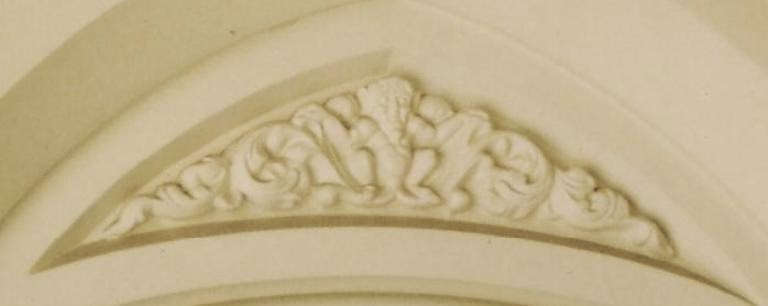
The engraver Anton Teutenberg was responsible for the vibrant sculptural detail of the Supreme Court. He arrived in 1866 and began work almost immediately. He was a gifted and versatile artist who is highly revered in numismatic circles for his beautiful commemorative medals of the early 1880s


Plasterers were still working on the site in the winter of 1875. (Daily Southern Cross 2 July 1865) The acoustics and the leaks continued to be worked on for many years.
We have on file a letter describing a first hand experience of approaching this building in 1876. 

'...The Supreme Court Building was a prominent feature of the high ground to the seaward side of the Barracks. The tower of the building could be seen some distance away and the contrast of white plaster detailing against red brick marked it as an unusually substantive structure in a town of predominantly weatherboard and single storey dwellings. In closer proximity realistically wrought heads of both worthies and demons peered down from the crenellated roof line....The dim entrance made a forbidding contrast after the bright February sun and heat outside .' BFA LL A.S

Yes. This listed building is one of our architectural treasures. It may be anachronistic. It may have a chequered history, but the sculptures Anton Teutenberg created, the window tracery the plasterers laboured over and the features Rumsey held as ideals in his mind are there for us all to enjoy. 


Thursday, 26 June 2014

Edmund Israel Matthews - Employer and Family Friend


One of the key early influences on the career of Edward Bartley was Edmund Israel Matthews.

Edmund Israel Matthews was born January 1810 at Queensborough, Isle of Sheppy. In 1842 he was Foreman of works, Department of Royal Engineers, Chatham, where his brother was also employed. He was sent out to Hong Kong in 1845 and promoted to Clerk of Works.

During 1848 he was brought to Auckland to replace Government Clerk of Works, George Graham. His first work was to supervise the completion of the Albert Barracks wall.[i] This wall enclosed an area just over 21 acres in the centre of the town.

Albert Park is now laid out on part of the Barracks enclosure. The two gates opened into what is now Princes and Symonds Streets.
Inside the wall was accommodation for 900 rank and file in wooden barracks.
A stone building known as the Grenadier Barracks, housed a further 100.


Image from Cyclopedia of NZ Sn 5 p 32

Facilities included a military hospital, sergeant’s mess room, commissariat, treasury and orderly room. The ammunition store was also of stone construction, surrounded by its own stone wall.


Officers of the 58th outside the newly completed barracks, including Matthew SLATTERY at extreme left, forebear of Wilma Amy Slattery, wife of George F Bartley. Original Image Ak Museum P660 with thanks.


The parade square was laid down in grass.
Although the citizens of Auckland had, thankfully, no cause to seek shelter behind the barrack wall, they did make use of the level green space for sports and public events.

Matthews designed and erected Wynyard Pier with the assistance of Royal Engineers and troops of the 58th Regiment.
Later he retired from service to conduct business on his own behalf as a contractor. His contacts and reliability ensured him the lion’s share of Government work. Edward was now 18 years of age.
In that year work began on the Mt Eden Gaol, under the supervision of architect Mr Reader Wood.
Matthews, with Edward under his wing, was one of the contractors involved in the construction.

Trading as Matthews and Bartley builders they were responsible for completing Rumsey's Supreme Court building in Auckland, which was originally begun by Amos and Taylor.

The Supreme Court Building with the Barracks visible in the left background BFA


Edmund Matthews was one of the original eleven who formed the first Congregational Church in Auckland, under Rev MacDonald.
His wife was Elizabeth Austin PIKE, christened 1 October 1812 Brixham, Devon, England. They were the parents of five sons and two daughters:

The eldest son was Seering Hall Matthews, was just a little younger than Edward Bartley. After working first in the departmental offices of the Colonial Secretary, he worked with Edward Bartley under his father. When Edmund retired Seering Hall Matthews and Edward continued the contract building business on until the depression of the 1870s.

Seering Hall Matthews married Amelia WALL 27 August 1862.
His son Seering Frederick Matthews ( b1870, Worcester), married Sarah Jane COURT, (b 1874, Birmingham, to John Court and Sarah BABINGTON.)
We know of two children born to Fred and Sarah- Rita May Matthews (b 12 December 1897 Auckland, d 1980) and Seering John Matthews (b 21 March 1900, d 1978)

Siblings of Seering Hall include: Frederick William Matthews was born 1845 in Hong Kong of Mangawhare; also Alfred James Matthews, of Auckland, who married Ellen POTTER; Edward Matthews of Auckland, Mrs A JOHNSTON, Mrs Rob MACDONALD of Sydney

Edmund ,Israel Matthews, his wife Elizabeth, and their infant son were interred at Symonds St Cemetery[ii]

More family information may be found at : http://www.myheritage.com/site-129822151/stewart


This clipping from the Auckland Star 13 June 1895 was found with Bartley family memorabilia.


[i] Auckland Waikato Historical Journal Sept 1991 No 59 p16 G B Abel
[ii] NZH 14 October 1895 p5 col 13