Sunday, 25 March 2018

Alva Martin Bartley- Architect of Landmark House Auckland


Alva consults the plans for Broadcasting House 

Today we introduce Alva Bartley, an Auckland architect influential during the interwar period.

The purpose of this post is to provide some biographical information and to clear up the question I get asked most often - was Alva a son of Edward Bartley?
The short answer is No. One of the implications of that fact I see as this- researchers may wish to reassess any assumptions concerning the influences on the architecture of Alva Bartley and Norman Wade. Just a thought.

Alva was born in Auckland in 1891, a son of Clement Bartley and grandson of Robert Bartley. As a 16 year old he passed the preliminary trades examination in technical drawing1 and three years later attained a first class pass in the South Kensington examinations. 2 At the end of 1910 he passed the Auckland Technical College programme in Architectural Design.3 Alva went on to study at Elam School of Art. 4 In 1917 he qualified 5 and married Alice Creamer.6He then embarked with the 30th Reinforements on 30 May of that year.7

There is much confusion in printed sources about Alva's pre-war study, which is why I am labouring the details in this early part of his story. Some commentators assert that Alva worked in the office of Bartley & Son before the war- the architectural practice of his great-uncle Edward Bartley in partnership with Alfred Bartley. If that is so no evidence has yet come to light. It is more likely a confusion around the identity of the A M Bartley working there - which was certainly Alfred Martin Bartley not Alva Martin Bartley. Alfred was indeed Edward's son and an architectural draftsman, but he was also an older man better known for his exceptional musical career than for design.

Alva may have had opportunity for further study while in Britain with our armed forces. His discharge documents are dated 29 July 1919 and he returned as associate of the Royal Institute of British Architects 8 We can estimate that date of return to New Zealand at late September 1919. The first tender advertisement for Alva Bartley and Norman Wade is dated October 1919, 9 from their presmises at the Brunswick Buildings in Queen St Auckland.10

Alva's business partner Norman Wade NZG 15 July1905

The Bartley-Wade partnership was a successful collaboration. Apart from the Power Board building, known as Landmark House, their designs include those for Radio NZ - the 1YA building and De Brett's Hotel. We take a closer look at some of those in later posts.


Landmark House 1929 Category 1 Historic Places Trust SGGSC 1104-8


1. ref NZH 23 Dec 1907
2. ref AES 7 Jan 1910
3. Ibid 23 Dec 1910 - note Malcolm Draffin also a classmate.
4. Ibid 2 July 1915
5 NZ Govt Gazette 1917
6. NZRBDM 1917/5858
7. ref AES 30 May 1917
8. WWI Attestation Sheets RB 56090
9. AES 22 Oct 1919
10. 174 Queen St. Both the Brunswick buildings and the Warwick Building next door were designed by Wade and Wade Architects and comprise two of the buildings making up the Canterbury Arcade.

Tuesday, 6 March 2018

The Auckland Mahlstick Club established in 1885 & Edwin Bartley


Auckland Mahlstick Club 1893. APL Image 5-1673. Artists include: Leech, John (Harold); Abercrombie, F J, Pheney, R, Bartley, Edwin, Holland, J C, Carter, C M, Drummond, R A, Horsley, J, Wright, Walter, Gregory, G, Stuart, S, Leech, H, Bollard, W A, Yearbury, J, Ball, T, Wright, Frank, Felkin, W, Trenwith, M, Debney, R J, Drummond, T I


A change of emphasis this week. While I was researching the Auckland Industrial Exhibition 1898, featured in previous posts, I noticed the quality of the art submitted for that exhibition. Clearly the arts in Auckland were flourishing and confident in the late nineteenth century. Exhibitions were a significant platform for established artists but what of the young ones coming through? What were their opportunities? This post looks at their Auckland 'art scene' and one organisation in particular - the Mahlstick Club.

The Auckland Society of Arts was an active organisation, particularly after its reconstitution in 1880. So there was ample opportunity to exhibit locally but within the conservative context to the required standard, on conventional subjects. The only venues for the collegial exchange of new ideas and expertise were personal and social and, by extension, invisible.

After the ASA exhibition of 1885 four artists responded with a solution of their own. The Auckland Mahlstick Club 1 was formed by  Thomas Ball ( first president), Thomas L Drummond, Mr Felkin and RJ Debney. Una Platts dismissed this group as 'a congenial group of ASA painters'.2 I submit they were more than that. They also had the support of a group amongst the old guard of ASA members, including Edward Bartley, Mackechnie and Peyton.

These older men were very aware of the potential a free, relatively 'classless' society offered here. Ideally, in New Zealand every person could improve themselves by the study of the liberal arts. They were 'liberal' because traditionally they were only available to the free man and not the slave. These men were interested in accessing knowledge for mutual improvement. They were practical people able to apply the latest technology and innovation in artistic expression as easily as engineering. The application of photography, projection and microsopy in their art is relevant here.

It may seem strange to a 21st century mind that such issues as the 40 Hour Working Week and free universal education should be playing out in the art world but they did- and still do, though today we tend to perceive the issues as more financial than philosophical.

Mahlstick Club membership was originally limited to 12 members. They laid an emphasis on black and white work – drawing and sketching in pen, ink, charcoal and chalk particularly. 3 Members gathered in each other’s house for sketching practice and to exchange ideas and information about art matters. They were young and emerging artists for the most part.

This was not a splinter group off the ASA but an enrichment group. They remained members of ASA and supported that society's exhibitions with a regular, high quality body of work.
The Club quickly gained the support of Frank and Walter Wright of Wright's Studios in Auckland. These men were Edwin Bartley's tutors. It is likely they introduced him and others to the 'inner circle' of this emerging art community. Its emergence was rapid too.4

The positive influence of the Mahstick Club on the study and practice of art in Auckland was acknowledged at the time.  After an exhibition of their work at an Athenaeum conversatione held in the Museum Institute 30 November 1886,5 the Society of Arts then took up their black and white theme  in their own exhibition in 1887, to which the Club contributed a number of drawings.

At the opening of that exhibition Mr Mackechnie, the president, not only reinforced the importance of sound drawing skills for artists. He laid emphasis on the wider applications of practical art training, referring to drawing skills as ‘the right hand of the workman and the mainstay of a technical education. If we are to have local industries and manufactures among us our people must have instruction in the art of drawing to acquire freedom of hand and facility of execution.’6
It helps us to understand that concerns over the lack of practical art, design and technical training facilities in Auckland formed the background to these remarks.

By 1891 the Mahlstick Club had over 20 members. A weekly life drawing class was held along with regular sketching expeditions. They now met in larger rooms with a more formal meeting structure.
NZH 8 Aug 1891

For the young ones coming through a goal was acceptance into the Cantebury art school. At this time the best teaching and most progressive climate was found in Christchurch. There a sister organisation, the Cantebury Palette Club, was soon formed with ex-pat Mahlstick Club members such as Edwin Bartley at its core.
A regular exchange of work between the centres formed an enriching inter-provincial dialogue. Works were loaned for exhibition in both centres. A strongly New Zealand voice was beginning to emerge now. The focus of attention was on place- their place and their time- rather than on European historical motifs as inspiration. There was less inclination in this Mahstick group to view the 'indigenous' place or person as a picturesque 'other' - a tendency of colonial period art discussed by Rebecca Rice in her 2010 thesis found here

The Mahlstick Club continued into the pre-war years, by then itself so 'establishment' an institution that papers presented to its meetings were published in full by the daily press.7 So the Great Wheel turns would you say?

1. A mahlstick is a piece of artist's equipment - a light stick with a padded leather ball at one end, held against work by a painter to support and steady the brush hand.
2. Una Platts, 'Nineteenth Century New Zealand Artists: A Guide and Handbook' 1979 Avon House page 163. Digital Copy here
3. Ref NZH 31 Oct 1891
4.Edwin Bartley is one example of the young men and women establishing their art practice in the 1880s and 90s. His career is covered in a previous post, found here.
5. Ref AES 26 Nov 1886, NZH 03 Dec 1886
6. Ref AES 20 Oct 1887
7. Ref AES 1 Aug 1908

Friday, 23 February 2018

The Grey Statue Auckland City


NZGraphic 05 Nov 1904


The Statue of Governor Grey now in Albert Park is one of early Auckland's signature pieces of statuary. The 21st Century Aucklander is likely to view this artwork and George Grey's career in a very different light to their 19th and 20th Century counterparts.

Edward Bartley was involved in this project. So today we explore the history of the statue -while gingerly stepping around the sensitivities associated with the gentleman represented.

A memorial committee was formed in 1898 to organise events and tributes associated with Grey's memorial day on 18 February 1899. This was a national memorial day, coinciding with similar events in Australia and South Africa.
During the Auckland Industrial and Mining Exhibition,1 which opened that year, donations to a memorial fund were collected. A special Exhibition Day was also organised, from which a portion of gate takings were allocated to the fund. 2
AWN 24 Feb 1899

Afterwards subsciptions were requested to top up the fund. A more permanent tribute was planned. The statue was commissioned in 1903, to which the Government contributed £100. The remainder of the cost - over £1800- was raised by those public subscriptions. It was a considerable investment made by Aucklanders.

In 1904 Edward Bartley was engaged to design a base for the statue. Once the site was finally agreed on he recommended that something in the style of Dublin's Oliver Goldsmith statue was appropriate.3

The Goldsmith statue, Trinity College Dublin. Image Dublin Tales visit here

The statue itself was produced in England by Francis J Williamson of London for £1260 and shipped to New Zealand by the Wakanui in September 1904.

This was a conservative selection of sculptor by the committee. Williamson received regular commissions from municipal and civic clients in the United Kingdom. His bust of the mature Queen Victoria was replicated many times. Critics noted his work lacked any fluid vitality but it was certainly 'appropriate' and fulfilled the intended function of commemmoration.

The marble statue was 8' high (2.4m). The granite for both pedestal and base were sourced from Coromandel, rising 14'6". Plaques on each side record Grey's service to the Empire and the tributes accorded to him by northern New Zealand:
NZH 21 Dec 1904

On 21 December 1904 the work was unveiled. Part of the proceedings included a phonograph recording made by Grey in February 1891.
AWN 29 Dec 1904

AWN 29 Dec 1904


The elevated site - at the intersection of Queen and Grey St- was well chosen. The fire-bell tower was there in Grey's time and formed a rallying point for political gatherings and temperance assemblies.

That it continued to be so is clear from this image of M J Savage addressing Aucklanders in 1912.

AWN 26 Sept 1912. note the statue's position relative to the Town Hall.


The Grey statue  moved to Albert Park in 1922, where it may be seen today. The stepped platform has been removed. This alteration to the proportions of the whole assembly presents a less than ideal composition. The work was never intended to retire into a restful or contemplative park atmosphere.

Image APL E7-23 Albert Park

It may be that the intention was to more remove Aucklander's political gathering place.  In declaring the Governor's memorial a traffic hazard were the civic planners hoping to dampen the rallying leadership of strong personalities -by then more feared than in colonial days?

Certainly statuary encapsulates the values of the times in which they were made. Each generation views their own cultural- and sculptural- story through the lens of their own time and debates their erection or removal accordingly. Historian Grant Morris discussed these issues in a September 2017 interview recorded here. Enjoy.

1. see more information here
2. NZH 24 Jan 1899
3. AS 26 May 1904

Sunday, 18 February 2018

Auckland Industrial and Mining Exhibition 1898 pt II


Last post we looked at Auckland Exhibition of 1898 and Ed Bartley's role on some of the organising committees. Here we consider the closing stages of that event and ask: what was the result?

In mid January an interactive display was held over two nights in the Choral Hall.
Here the public had the opportunity of seeing experiments in electro/magnetism and other aspects of physics provided by the University College. For many this was their first exposure to the potenial uses of electricity.
Edward Bartley and other members of the Auckland Microscopic Club were on hand with the largest collection of microscopes ever seen in the region. There were 100 laid out with specimens which the public were invited to view.1 Edward was a founder member of the organisation, which was formed in 1885, and included fellow Auckland Institute members J A Pond and Josiah Martin.
This educational focus on innovation in science, technology and research was key to the Exhibition.

A Portrait Image c 1900 BFA
The push to establish a full time technical school in Auckland was also advanced by the exhibition. Edward was one of the founders of the Auckland Technical Association which had been campaigning for technical training in Auckland. By 1895 evening classes were available but there was still no  daytime programme for school leavers. Wellington already had such a school run by the Education Board on the South Kensington School curriculum.

Only two months after the exhibition the Education Board was making enquiries about a site in Wellesley St to be a combined teacher and technical training facility. Despite the support of the University College for pre-tertiary technical training, it was the Auckland association that provided a day school. The Auckland Technical School opened in 1903.

The exhibition also measurably advanced educational opportunities for the blind. Dr Purchas' braille printing machine was both invented in Auckland and first exhibited at this Auckland event. It allowed for a semi-mechanised production of braille type by impress on a copper drum- a huge improvement on the hand punching method then in use.2

Buoyed by their local success some Auckland exhibitors were already looking to London and to the proposed Paris Exposition Universelle, the international celebration of the new century of commercial opportunity. This was a world fair due to open on 14 April 1900. The Greater Britain section had provision for New Zealand exhibits.

The Auckland exhibition was visited by Hon L L Smith of Victoria - a member of the executive committee for Greater Britain representation. In an open letter to the press he expressed the view, with regard to Paris: 'you have here the nucleus...of a first class New Zealand exhibition.'3

Northern businessmen were keen to make their own arrangements. For example the Thames Machinery Company made offers to their counterparts in Victoria and Queensland to mount a joint display of cyanide extraction techniques.4

In late January the Governor's office advised the premises would be required on the 1 March.

NZH 18 Jan 1899

There was earlier such an outcry at a suggested closing date of 18 February that the exhibition remained open until the last available day -28th February. Not only did the event run at a profit, it was held to have fulfilled the intentions of the Auckland Chamber of Commerce in that it performed 'all that was expected of it as a public educator and an advertising medium for the products of the colony.'5 

The buildings were purchased by the industrialist JJ Craig of Auckland.

The Exhibitor award medals for the exhibition. Image AWMM


For those interested in the history of exhibitions and world fairs we recommend a visit here
You may enjoy a rare film archive of Exposition Universelle Paris 1900 here


1. NZH 18 Jan 1899- 20 Jan 1899
2. Ibid 14 Jan 1899. For Dr Purchas' biography see here
3. Ibid 30 Jan 1899
4. Ibid 16 Mar 1899
5. Ibid  28 Feb 1899

Sunday, 4 February 2018

Auckland Industrial and Mining Exhibition 1898-99

The opening of the Auckland Exhibition, Auckland Weekly News 9 Dec 1898

Welcome back everyone. We are starting the research year of 2018 with a look at a summer spectacular - open from December 1898.

This is a longer post than usual. The main reason is that there is little material available in an accessible form on this topic. Our connection is Edward Bartley's involvement but we also touch here on the early history of the 'University Precinct' of Auckland- Princes St, Symonds St in particular.

In 1898 Auckland put on a great extravaganza - the Industrial and Mining Exhibition - which was part of a worldwide phenomenon begun in Europe in 1851 and continuing until the Great War.

Any adult attending the Auckland Exhibition that year could be said to belong to the 'exhibition generation'. Certainly Edward Bartley was a good example of this. He was there with his family at the Great Exhibition in London during the summer of 1851 - aged 11.

This image published by the Guardian shows the Great Exhibition buildings, London, visited by 6 million people

Coming to New Zealand three years later he must have been struck by the contrast - from Paxton's great glass house filled with technology and international design to the single storey timber stores on Auckland's waterfront.
We know he was also struck by the exquisite natural beauty of this country-first seen at that Great Exhibition- beginning his lifelong engagement with New Zealander timber, stone and vegetation.

This trans-national inter-connecting effect of the 'Exhibition' was hugely influential in forming aspirational and international patterns of thinking and being in the world. This theme has recently been explored by New Zealand historians.The PhD research of  Ewan Johnston specifically concerns the representation of Pacific peoples at exhibitions up to 1940. For this and relevant recent research refer here.

The proposal to mount an exhibition in Auckland was presented in January 1898 by the Auckland Chamber of Commerce whose president Mr Bart. Kent chaired the Executive Exhibition Committee.

The many committees and sub-committees included influencers in every area of endeavour active in Auckland at that time. Five acres were made available for showgrounds at the former Government House grounds, entered via Princes St in the central city. 70,000 square feet of covered space was specified, a cycling track and associated detached structures.

Edward was elected to the Building and Lighting Committee and to the Arts and Decorating Committee. His involvement with the Society of Arts was valued on the latter. The Choral Hall in Symonds St was to be the venue for an art exhibition open to all art society members throughout Australia and New Zealand.

Architects appointed to the Building Committee all had a hand in designing the centre piece - the main exhibition hall. De Montalk, Skinner and Arnold presented concept drawings for discussion.
Final plans were presented to the Executive, drawn up by Robert de Montalk, and accepted in April 1898.1

Sketch of the Proposed Exhibition Buildings Auckland 1898 AWN 28 May 1898


NZH 2 May 1898

This image, taken just before the opening ceremony shows the main entrance and orientation of the exhibition buildings. AWN 9 Dec 1898

The cycle track designed for the event was of concrete construction, banked for racing 5 laps to the mile. A running track was provided in the centre


The cycle track under construction AWN14 Oct 1898

The Cycle Track viewing area during the first day of the exhibition AWN 9 Dec 1898

One main focus of the Exhibition was the mineral resources of the region.  Organisers clearly intended to improve on the successful exhibitions already held in more southern provinces. 
In the words of the NZ Herald the event was 'an incontrovertible assertion of our industrial progress and an undeniable advertisement of our mineral resources.'2

Auckland emphasised the diversity as much as the technology. Coal and kauri gum from Whangarei, Dargaville and further North was found in the Minerals Court, with the latest mining and processing technology from the  gold mining strongholds of Coromandel and Thames.

The Story of Gold, as told by the Hauraki Region AWN 25 Nov 1898


Security was necessarily tight for the duration of the exhibition. Here officers are on duty at the Northland stand. AWN 16 Dec 1898 

It is noticable in the accounts and images that the standard of presentation and the content of the displays was far higher in 1898 than a modern 'expo' goer would be likely to meet today. Visitors expected to be informed as well as entertained. Some exhibitors, such as the Thames School of Mines, for their part, expected to attract a new generation into the industry.

Meanwhile in the manufacturing hall crowds of spectators gathered around the working looms of the Onehunga Woollen Mills. These recently imported machines were demonstrated by trained operators who invited close questioning by their audience.3

Luxury manufacturing in the province was also strong feature of the event. Then as now Auckland looked to American and Australian trends as much as British or local ones.


The Luxurious stand of Iredale's Ladies Wear - note the high standard of joinery and fittings on this temporary display.

A sophisticated refreshment stand - the Nathan's kiosk sold teas and iced teas throughout the event. AWN 10 Feb 1899

Arts, cultural  and sporting prowess in Auckland was equally celebrated at this exhibition. In addition to the modern sport of cycling, demonstrations of rhythmic gymnastics for youth of both genders looked forward to the health movements of the coming 20th century.
A particular highlight was the Exhibition Choir, of 600 voices, with orchestra and invited soloists performing Arthur Sullivan's 'The Golden Legend'. Music recitals and concert performances, both at exhibitor stands and other venues, occurred throughout months of the exhibition.

In our next post we consider the closing of the Exhibition and how it affected the region.


1. ref NZH 29 April 1989
2. ref NZH 28 May 1898
3. ref NZH 14 Dec 1898

Saturday, 27 January 2018

Auckland Anniversary Day

Welcome to a New Year and Auckland Anniversary weekend 2018.
Today we take a look at Auckland Anniversary celebrations from early in Auckland's history.
DSC 28 Jan 1864
 In the 19th Century Aucklanders joined with visitors in jostling for the best vantage points from which to view the races, just as we do today. They lined the shores on both sides of the harbour and established theselves with picnic gear, hats and binoculars. Those well practicsed in the art took their stand on a favourite headland or elevated verandah, such as Bastion Point and Mt Victoria - both well aspected for shade, viewing range and ventilation.

Our ancestors expected to make a day of it too. Extra licenses were issued for pop up stores selling snacks and meals, bars were open all day on both land and sea.

Looking over Queen's Wharf from the western side at the Regatta entrants on the Waitemata APL4-RIC-154


DSC28 Jan 1864


Ibid

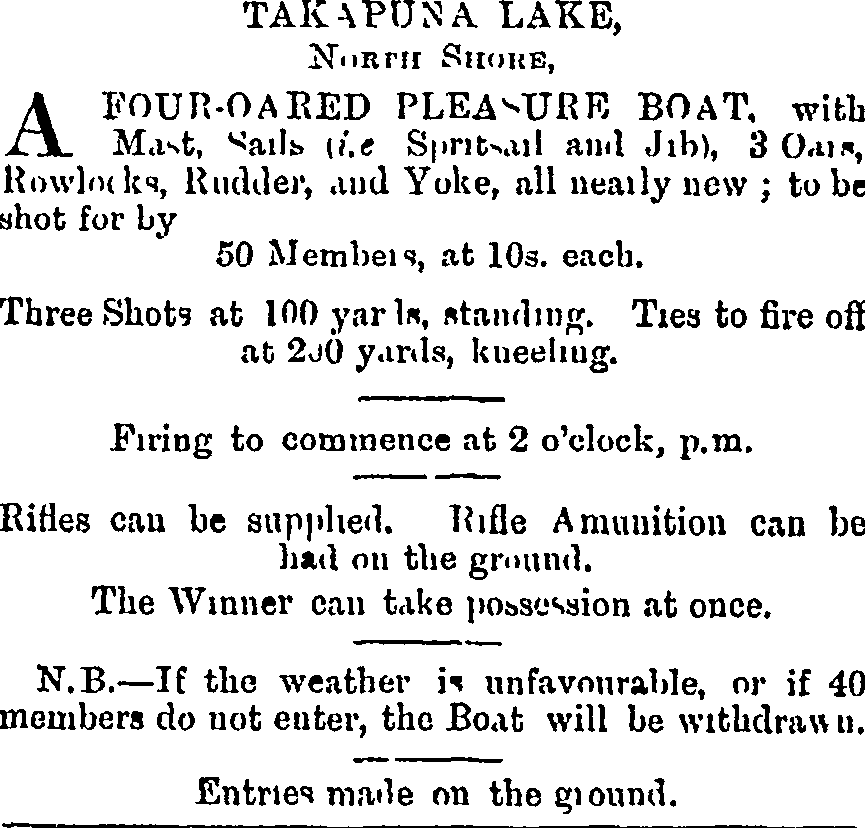
The North Shore specialised in festivities and special events during the 19th century. This popular destination for outings and day trips hosted a special Anniversary Day extravaganza every year. Action centred around Takapuna's Lake Pupuke. Ferry passengers arrived early and stayed late to make the most of a full programme.

Ibid


Crack shots competed at a rifle range for prizes, horse racing was on the cards, with fresh water racing on the Lake itself. In the evening the Grand Marquee on the Promenade provided an open air ball room.


Ibid


Takapuna Beach provided a perfect Harbour view of the main Regatta and was renowned for the relaxed and sociable atmosphere. Ferries came and went during the day with special night sailings for the last of the party goers making their way home.

This image shows the same occasion 35 years later in 1899. The Promenade was aptly named. AWN 3 Feb 1899

Our 21st century Auckland is a world away from our settlement days but we can still keep our heritage in mind.  If you are interested in celebrating our city's origins in 1840 the Maritime Museum has a full programme of activities on offer, including the opportunity to sail out on some restored colonial period craft. You find details of sailing times here. Other activites and events are highlighted here. Enjoy.


Monday, 9 October 2017

Exploring Heritage Matters


Auckland is into the second week of its Heritage Festival  now with plenty of events for enthusiasts of our built heritage. There is an overall theme of transportation in this year's festival but I noticed two events coming up of relevance to Bartley and Devonport researchers.

St Matthews in the City. Image Postcard Collection BFA

Peter Reed, architect, leads an exploration of St Matthews in the City next Saturday 14 October. Edward Bartley was supervising architect for this 1905 landmark as part of his role as architect to the Anglican Diocese of Auckland.
Tour details here
Information on the construction of St Matthews here

Torpedo Bay 1879 Image APLSGGSC4-2979

For those whose Auckland roots lie in Devonport there is an opportunity to tour the earliest sites of commercial activity. Details of the Maritime self guided tours on all week are here and information on the pioneer boatbuilders here
Edward Bartley's first home on the North Shore was on the foreshore at Devonport. He was a neighbour to William Holmes whose house and family feature in the promotional material for this event. Edward's eldest son Arthur married William's neice Polly Holmes

Holmes family home and boatyard about 1880. Image APL SSGSC

If you are going to Devonport by car please do visit O'Neill's Point cemetery and see Edward Bartley's grave restored. There are several other Bartley graves in the cemetery.

Judging by the response to our post Frank and Dorothy's project has inspired  other families to identify and care for family plots. Well there is good news. It has never been easier.

Bartley Archive holds some information on family graves, and a few photographs of plots. Do get in touch at the start if you have Bartley Channel Islands links. We may be able to help if other researcher's contributions included burial records.

The first step in fresh research is to obtain an 'address' for the plot. Many cemeteries now have an online database available to search. For example Auckland Council has access for burials and cremations in the region on this page

Image BFA 2014

Most of the larger public cemeteries have maps online or available at the office for the second step -which is locating the plot itself. On the basis of past experience I would recommend a party of two or more people, good walking shoes, good humour and an openess to synchronicity. Keep your ancestor in mind and your camera in hand-some of these places are very beautiful landscapes too.

Purewa Cemetery, St John's Auckland. Image BFA 2012


Saturday, 30 September 2017

Edward Bartley's Grave Restored


It is a great pleasure to be writing this post. On behalf of Edward's descendants we give a great bouquet of thanks to Frank and Dorothy Bartley who have undertaken and carried out the restoration of the Bartley gravesite at O'Neill's Point Cemetery, Devonport in Auckland.
With the site cleared Dorothy discusses the state of the headstone. Image F&D Bartley 2017

As visitors to the cemetery will know the plot was in a sad condition. Time and some vandalism during the late 20th century left us little to be proud of. Fortunately Frank and Dorothy were on hand in Auckland to closely oversee the project from the outset. The work was carried out by Steven Webb, of Monumental Headstones and Plaques Ltd,  who was able to salvage the marble and some surviving iron fittings.

Marble reinstated, remaining ironwork cleaned and returned to original placement, with work proceeding on re-erction of the headstone. Image S Webb 2017

The completed reinstatement and restoration of the gravesite September 2017. Image F&D Bartley 2017


Edward's wife Elizabeth Hannken also lies in this plot, along with their sons Percy and Claude  (husband of Cassie Tooher). Edward's daughter Bertha Bartley, wife of Frank Mason, lies nearby in the Mason family grave.
Frank Bartley stands with the reinstated headstone. The buff pink marble obelisk behind his shoulder is the Mason family plot where Bertha Bartley is interred. Image F&D Bartley 2017
Edward Bartley and Family Image BFA
Once again thank you Frank and Dorothy.